Types of Keyboard Key Action: Synth, Semi-Weighted, Hammer and Graded
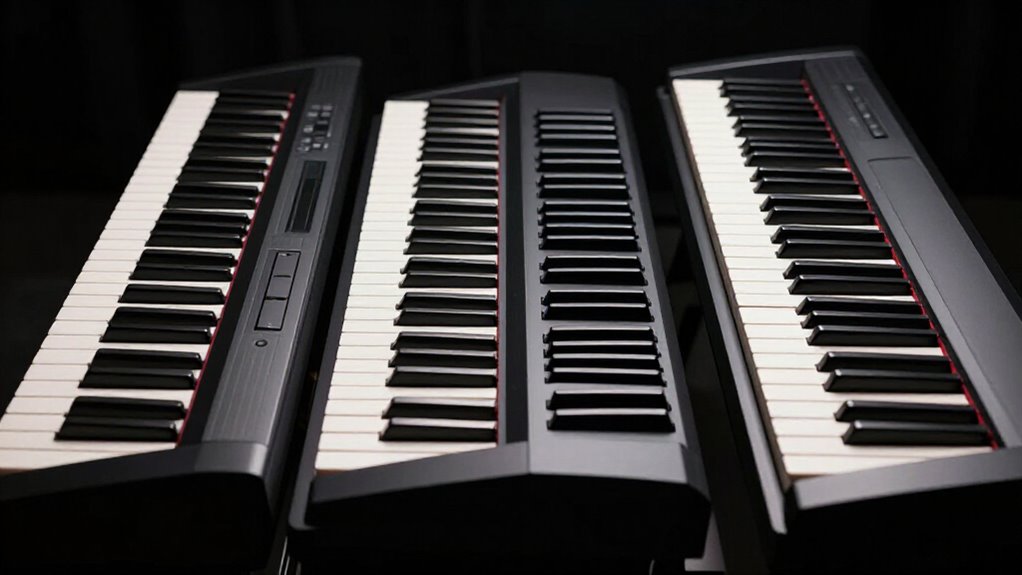
You’ll choose synth action for light, even spring response, fast repetitions, and organ or lead parts. Semi-weighted keys add resistance while staying relatively quick and uniform. Hammer action uses weighted mechanisms for more piano-like inertia, dynamics, and release control. Graded hammer action makes bass keys heavier and treble keys lighter, closely matching an acoustic piano.
Touch sensitivity and aftertouch are separate features, not proof of weighting. Compare travel, rebound, fatigue, and register-to-register consistency next.
Springs, Hammers, and Sensors
Keyboard action begins with the mechanism that resists your fingers and measures each press. Synth-action keybeds rely on springs, not hammers or weights, so you encounter a light return force. Semi-weighted designs retain spring operation but may add masses, giving you firmer resistance without duplicating an acoustic piano mechanism.
Hammer-action keybeds move hammers or hammer-like assemblies, producing resistance to piano playing. In an acoustic piano, your key press throws a hammer into a string; when you hold the key, the mechanism prevents the hammer from returning to rest and damping the string. Some hammer actions use sensors that register a hammer’s return under its weight after release. Touch-sensitive sensors track strike speed or force, letting the instrument alter volume, timbre, or response parameters.
Graded Bass-to-Treble Resistance
Graded action makes the bass keys feel heavier and progressively reduces resistance toward the treble, mirroring an acoustic piano’s touch. You encounter this distribution because lower acoustic strings are longer and thicker, so their hammers need different force to sustain consistent volume and resonance.
| Register | Resistance | Playing result |
|---|---|---|
| Bass | Higher | You can shape weighty attacks. |
| Treble | Lower | You can articulate lighter lines. |
Compared with uniform actions, graded hammer mechanisms give you register-specific leverage for touch control, voicing, and dynamics. Manufacturers may weight every key individually or divide the keyboard into zones sharing similar resistance. Because the gradient is fixed, you can’t flatten its feel; players seeking a consistently light, uniform response for synth or organ techniques may find it restrictive in fast passages sometimes.
Hybrid Wooden-Key Actions
Hybrid wooden-key actions pair wood keys with modern hammer mechanisms to give you a more acoustic-piano-like interface. While wood can improve perceived authenticity, key weight, length, sensors, and graded resistance more directly determine response and control. You should compare actions in person, since a hybrid design’s realism depends on its mechanism rather than wood alone.
What Defines Hybrid Actions
A hybrid wooden-key action pairs wooden keys with a piano-style hammer mechanism to produce a more acoustic-like response than a conventional plastic-key action. The term describes a construction category, not a uniform engineering standard. When you compare models, separate the key material from the action geometry: wood forms part of the key structure, whereas hammer travel, counterweights, pivot placement, and return design govern resistance, inertia, and repetition.
Manufacturers may use extended key lengths or revised pivot locations so you retain consistent leverage when playing away from the key front. Many also apply graded weighting, making bass keys resist more than treble keys. Unlike a basic weighted plastic action, a hybrid design combines these structural and mechanical elements, but implementations vary. Compare mechanisms; try it.
Wooden Keys And Feel
Wooden keys can add structural rigidity and a more piano-like tactile character, but they don’t by themselves determine how an action feels. You should treat wood as one design variable, alongside plastic construction and surface coatings that may alter contact texture.
For a closer acoustic-piano comparison, assess key weight first. Greater resistance and controlled return usually influence perceived piano-like behavior more than the core material or finish. A wooden-key keyboard can feel light, firm, or uneven depending on its weighting, hammer design, and keybed geometry. Test resistance and response at low, middle, and high registers; don’t infer weighted or graded behavior from a wooden-key label alone. Compare initial resistance, travel consistency, and release response across the range before deciding if it suits your technique.
Hybrid Action Mechanisms
Rather than relying on wood alone, hybrid wooden-key actions pair wood-based keys with hammer mechanisms that simulate acoustic-piano resistance and momentum. Compared with all-wood or plastic-key designs, these mechanisms let you evaluate material. The hammer assembly determines much of the downweight, return behavior, and perceived inertia, while the wooden key contributes a structural feel.
In graded versions, you encounter firmer resistance in lower registers and progressively lighter resistance upward. Sensors can track key travel and hammer response, allowing the instrument to translate variations in movement into control data. Because implementations vary, you shouldn’t treat “wooden-key” as a performance specification. Test the action directly when possible: compare resistance across registers, assess how promptly keys return, and check whether sensor response remains consistent at different playing speeds.
Acoustic Piano Realism
Acoustic-piano realism in a hybrid wooden-key action depends more on its hammer mechanism, weighting, and return behavior than on the presence of wood. A wooden key can provide the familiar surface and construction associated with an acoustic instrument, but it doesn’t by itself reproduce acoustic mechanics. You should instead examine whether the action uses a piano-style hammer assembly that creates resistance during descent and allows sensors to register the key as it releases. Graded hammer designs improve the acoustic comparison by making lower-register keys heavier than upper-register keys, reflecting the resistance pattern of an acoustic piano.
Hybrid actions pair this mechanical design with digital electronics, so their realism comes from how accurately those components simulate piano behavior. Prioritize mechanism and grading, not wood alone instead.
Weight, Response, And Control
Hybrid wooden-key actions use a hammer mechanism to create resistance and rebound closer to an acoustic piano, but their control depends chiefly on the action’s weighting and response. Graded designs make lower keys heavier and upper keys lighter, matching the changing hammer force across an acoustic piano’s register. This variation can give you more consistent leverage and dynamic control from bass to treble than uniformly weighted actions.
However, wood alone doesn’t determine authenticity: pivot length, key travel, hammer calibration, and sensor design shape how accurately the instrument detects velocity and how predictably it repeats notes. A longer key may improve control near the key’s rear, while responsive sensors preserve subtle dynamic changes. Because model-to-model differences remain substantial, test weight, rebound, and repetition yourself first.
Ideal Players And Uses
Pianists who prioritise acoustic-style resistance and dynamic control will usually benefit most from hybrid wooden-key actions. You’ll find them especially suitable if you play classical repertoire, study technique, or need an acoustic-inspired practice instrument. Wooden keys paired with a hammer mechanism provide substantial inertia and a weighted response, letting you regulate attack, voicing, and loudness more predictably than with synth or semi-weighted actions.
If you choose a graded version, bass keys feel heavier while treble keys lighten, closely reflecting acoustic piano geometry. This helps you develop repertoire-specific touch, but its fixed traditional weighting can hinder rapid organ smears or synth parts. Try the action in person: key weight shapes adaptation more than wood, coatings, or surface texture. Test repetition and fatigue across registers first.
Organists, Producers, and Pianists
If you play organ or synth parts, synth-action keys give you fast, uniform spring response for rapid repetitions and controller work. If you produce across organ, synth, and piano sounds, semi-weighted keys provide moderate resistance, though their return can feel slower in glissandos. If piano technique is your priority, hammer action, especially graded hammer action, gives you the resistance and bass-to-treble weighting you’d expect from an acoustic piano.
Organists and Synth Action
Organists and synth players often prefer synth-action keys because their spring-loaded, unweighted design delivers a light, uniform response across the full range. You can execute rapid passages, repeated notes, palm smears, and chord changes with less effort than on hammer-based actions. Because every key offers comparable resistance, your manual technique remains consistent from bass to treble, matching the feel and control logic of many organs.
On a synthesizer, you don’t depend on key mass to create expression: you shape attacks, filters, modulation, dynamics, and pitch through patches, controls, and wheels. This action also keeps instruments portable for multi-keyboard rigs. However, if you regularly move to an acoustic piano, you’ll need to recalibrate touch, since synth action provides neither hammer inertia nor a heavier bass register.
Producers: Semi-Weighted Keys
Semi-weighted keys give producers a middle ground between the speed of synth action and the resistance of weighted piano actions. Their spring-based mechanism, sometimes supplemented by small weights, gives you light-to-moderate resistance without simulating an acoustic piano’s hammer movement. You’ll trigger rapid repetitions, runs, and layered synth or organ parts efficiently with more control than a synth-action board provides.
Unlike graded hammer actions, semi-weighted keys maintain relatively uniform resistance across the keyboard. This consistency helps you move between bass lines, chords, and lead parts without compensating for heavier lower notes. It also reduces instrument weight and cost, making transport and studio setup easier. If you’re learning piano, you can develop coordination here, but expect a different touch and dynamic response on an acoustic piano.
Pianists Need Hammer Action
For pianists, hammer action provides the closest controller feel to an acoustic piano: its weighted mechanism resists your fingers and supports finer control over touch and dynamics. That resistance lets you regulate key velocity more deliberately, shaping soft attacks, accented notes, and dynamic changes with less reliance on electronic response curves. Unlike semi-weighted designs, which primarily combine springs with modest added mass, hammer mechanisms simulate the inertial load you encounter at a piano key.
Graded hammer action extends this similarity: bass keys feel heavier and treble keys progressively lighter. You don’t need hammer action to begin learning piano, but weighted keys develop controlled finger force and release. Grading also makes the physical shift to an acoustic piano more familiar, especially when repertoire demands voicing.
Matching Action to Role
The best key action depends on the parts you play often and the response you need under your hands. If you’re an organist, choose synth action for its light, spring-loaded return and passagework. Semi-weighted action adds resistance without sacrificing speed, making it an effective organ-focused compromise.
If you produce or play synthesizers, synth-action keys provide a uniform, lightweight response. They support note entry and leave you free to work pitch wheels, modulation controls, and patches. If piano is primary, fully weighted hammer action gives you resistance closer to an acoustic instrument, improving timing and dynamic control.
Graded action goes further: bass keys feel heavier, while treble keys feel lighter. For mixed roles, balance piano-like resistance, speed, and portability; semi-weighted bridges hammer and synth action.
Match Key Travel to Repertoire
Choose key travel and resistance according to the parts you’ll play most: synth-action keys respond quickly and evenly for synth leads, organ work, and fast passages, while semi-weighted actions balance lighter travel with some piano-like feedback for mixed repertoire.
If piano dominates, choose hammer action: its hammer-like mechanism supplies greater resistance and a rebound profile closer to an acoustic piano, letting you control attacks and expressive dynamics with familiar leverage. For the closest acoustic relationship, choose graded hammer action; lower notes feel heavier, upper notes lighter, so your technique tracks a piano’s bass-to-treble weighting. Semi-weighted keys can still work across styles, but their potentially slower return can hinder glissandos and rapid repeated notes; test those figures before committing during your normal playing sessions.
Dust, Lubrication, and Repair Costs
Dust affects any key action, but tightly spaced electronic keyboards can develop sticky or sluggish keys when particles enter the gaps. Synth and semi-weighted mechanisms have narrow clearances, while hammer and graded actions add moving parts, yet both benefit from prevention. Keep your keyboard covered when it isn’t in use, and wipe it with a soft, dry cloth. Don’t spray cleaner or lubricant into key gaps: liquid can harm electronics, and residue collects dust.
Lubricate only when manufacturer’s service instructions specify a product and procedure; incorrect compounds can bind mechanisms or degrade plastic. If a key sticks, clicks unusually, or won’t return, don’t force it or dismantle the action. Request inspection, then obtain a written diagnosis and estimate. Costs depend on model, parts, and labor.
Aftertouch Isn’t Key Action
Aftertouch is an expressive control rather than a key-action type: it senses added pressure after you’ve depressed a key, often assigning that pressure to vibrato, modulation, or another parameter while the note remains held. It doesn’t determine whether you feel a light synth-action, a resistant semi-weighted design, or a hammer-action mechanism. Those categories describe travel, resistance, mass, and return behavior; aftertouch reads force beyond the initial key strike.
A keyboard can combine any action with aftertouch, or omit it entirely. Accordingly, compare the specifications independently: action determines your physical playing response, whereas aftertouch determines a held note’s pressure-based control. MPE controllers, including the Expressive E Osmose, extend this concept to per-note expression through customizable Z-axis control. Check key specs: neither predicts the other.
88-Key Picks Under $1,000
For an 88-key piano under $1,000, prioritize action before price: standard weighted keys provide uniform resistance, while graded hammer actions increase resistance in the bass and lighten it toward the treble.
- Choose graded hammer action if you’re taking lessons, playing classical repertoire, or switching to an acoustic piano; its bass-to-treble weighting closely replicates acoustic mechanics.
- Standard weighted, non-graded keys support early study economically, but retain consistent resistance across registers.
- Verify specs: touch-sensitive only links playing force to volume or tone; it doesn’t confirm weighted keys.
Try full-size models in person when possible. Labels don’t establish playability; compare travel, resistance, and return across the range. Also assess pivot length, key spacing, noise, and control consistency before committing to a instrument for practice.
Conclusion
You’ll choose better when you separate feel from features. Synth actions favor speed and portability; semi-weighted designs add control; hammer and graded actions reproduce piano resistance across the range. Hybrid wooden keys can improve leverage, but they also raise cost and service complexity. Match travel, return force, and sensor response to your repertoire, then budget for cleaning and repairs. Don’t mistake aftertouch for action quality. Under $1,000, prioritize a reliable 88-key mechanism over extras.