Weighted vs Semi-Weighted Keys: Which Feel Suits Your Playing?
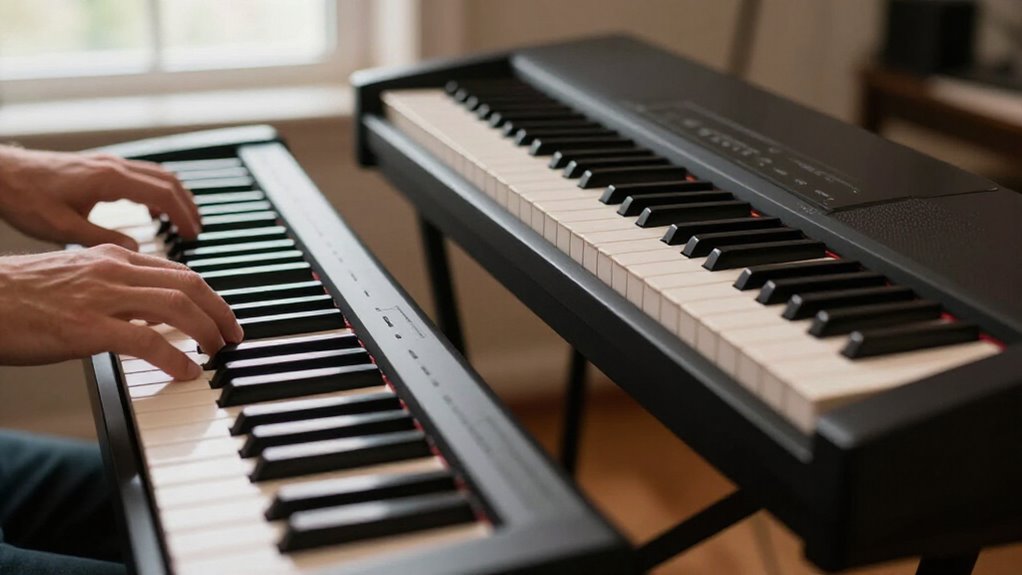
Choose weighted, preferably graded hammer, keys if you want resistance, rebound, and bass-to-treble feel that support acoustic-piano technique.
Choose semi-weighted keys if you need a lighter, springier response for fast organ, synth, DAW, or live-rig parts.
Key weight doesn’t determine velocity curves, aftertouch, or mechanical noise, so test those separately.
An 88-key range preserves full piano repertoire, while stand capacity must safely exceed your setup’s combined weight.
The details ahead help you compare actions confidently.
Hammer Action vs Springs
Hammer-action keyboards use weighted levers or hammer-like mechanisms to reproduce the resistance and rebound of an acoustic piano, while semi-weighted keyboards rely primarily on springs for key return. With graded hammer action, you encounter greater resistance in the lower register and lighter keys higher up, mirroring piano geometry. This mechanism supports piano technique because your fingers manage mass rather than only a spring-driven return. Semi-weighted designs may add small weights, so you get more resistance than unweighted synth keys without full hammer behavior. Their lighter, faster response can favor rapid organ or synth passages. Choose based on repertoire needs.
| Mechanism | Your feel | Typical use |
|---|---|---|
| Hammer levers | Mass-based resistance | Piano technique |
| Springs, sometimes weighted | Lighter return | Organ or synth |
| Unweighted synth | Minimal resistance | Electronic parts |
Escapement Simulation and Spring Tension
Beyond overall key weight, some digital pianos add escapement simulation: a slight tactile let-off near the bottom of the key travel. On an acoustic piano, it occurs when the hammer disengages just before it strikes the string. In a digital action, it is a separate cue, not proof of weighting or a hammer mechanism.
Spring tension affects how you perceive resistance and return. Semi-weighted actions use springs, sometimes with weights, so you may feel a lighter, more elastic press than on a fully weighted graded hammer action. Graded actions place more resistance in bass keys and less in treble keys, but their labels don’t specify spring tension. Action labels aren’t standardized, so test the keyboard in person: assess the let-off and spring resistance yourself.
Velocity Response and Repetition Speed
Velocity response determines how your key-press speed translates into note volume, regardless of whether the keyboard uses weighted or semi-weighted keys. This touch-sensitivity setting is independent of key weight: faster, harder strikes usually trigger louder notes, while gentler presses produce quieter output. Many instruments provide three to five, or more, response curves, so you can set how readily playing velocity changes dynamics.
Semi-weighted actions use lighter, spring-assisted mechanisms, which can support rapid repeated notes and quick organ or synth figures. Weighted actions resist your fingers more strongly, giving you a firmer platform for piano-oriented dynamic control. That resistance can make repetitions feel less immediate, whereas semi-weighted keys typically return with less effort. Response curves affect both designs, but can’t fundamentally change their mechanics.
Beginner Practice Adjustment Period
When you move from semi-weighted to fully weighted keys, expect an adjustment period: the greater resistance and slower-feeling key return can initially make familiar passages feel less secure without indicating weaker technique. Begin with slow, familiar material, and use quiet attacks, repeated-note control, and chord balance as diagnostic tasks. Play five adjacent notes softly and evenly; then repeat a three-note chord at soft, medium, and strong levels to compare force requirements and velocity control.
Practise regularly on the action you use for lessons, because consistent resistance calibrates finger force and release timing. Occasional acoustic-style practice can bridge the difference. A lighter action may better suit a young or cautious beginner; reassess it as lessons, repertoire, and dynamic-control demands develop. Don’t confuse adaptation with limitation.
DAW Controllers and Live Rigs
For DAW control and live performance, semi-weighted keyboards often suit synth and organ work because their lighter, spring-assisted action supports rapid notes, repeated attacks, and quick releases. Their lower mass reduces what you carry between rehearsals, studios, and gigs. For piano, velocity sensing translates strike force into output level.
Test repeated notes, then play soft-to-loud chords using your normal velocity curve and DAW instrument settings. Listen for consistent triggering, sufficient dynamic range, and control at fast tempos. If one controller must cover piano and synth duties, prioritize the repertoire you play most.
A fully weighted hammer action gives more piano-like resistance and leverage, but adds transport weight and can slow rapid organ-style repetitions. Choose it only when its piano response outweighs those live-rig compromises.
Replacement Keybed Parts Availability
Serviceability can matter as much as feel if you expect to keep a keyboard through frequent transport and heavy use. Neither weighted nor semi-weighted action automatically guarantees that you can source replacement keybed components. Parts support depends on the manufacturer, the specific model, its production age, and the service network.
Before you purchase, verify four practical details:
- Ask the maker whether it supplies keybed assemblies, individual keys, contacts, springs, or sensors.
- Confirm the exact model and revision, since similar keyboards may use different mechanisms.
- Check whether an authorized service provider can order and install the required part.
- Document availability before committing, because catalog status, pricing, and suppliers can change.
Don’t infer repairability from action type; compare documented parts access closely by model before purchase.
Stand Weight Capacity Limits
Stand capacity sets a hard safety limit, so compare its stated maximum load with the combined weight of your keyboard and any equipment it will carry. A fully weighted digital piano often imposes a greater load than a semi-weighted model because its action and chassis add mass. For reference, the Roland FP-30 is listed at 40 pounds, while the semi-weighted Alesis Recital is listed at 16 pounds.
These figures don’t establish a suitable stand by themselves; you must check the stand’s rating against the instrument, sustain pedal hardware, accessories, and anything supported by its frame. Follow the manufacturer’s assembly, height-adjustment, and load-distribution instructions. Position the keyboard as directed so its center of mass remains within the stand’s supported area, and never exceed capacity.
Aftertouch Availability Differences
Aftertouch registers pressure you add after striking a key, giving you control beyond initial velocity. You can’t assume a weighted hammer-action keyboard includes it, and semi-weighted models don’t guarantee it either, though some pair semi-weighted triple-sensor keybeds with aftertouch. Check each model’s specifications and test its response, because implementation varies.
Aftertouch On Weighted Actions
Key weighting doesn’t determine whether an instrument supports aftertouch, which senses continued pressure after a key reaches its initial strike. On a fully weighted hammer action, aftertouch requires sensors or switching designed to register extra key-bed pressure beyond the velocity measurement taken at impact. Consequently, many weighted digital pianos omit it, even when their actions accurately emulate acoustic resistance. Before you buy, verify four points:
- The specification explicitly lists aftertouch.
- It identifies channel aftertouch, if included.
- It identifies polyphonic aftertouch, if you need independent control of held notes.
- Documentation distinguishes aftertouch from velocity sensitivity.
Channel aftertouch applies pressure value across the keyboard; polyphonic aftertouch tracks held notes separately. You’ll get answers from specifications, because hammer weighting alone reveals nothing about pressure sensors or implementation.
Semi-Weighted Aftertouch Options
Semi-weighted actions use spring-based resistance, but that mechanism doesn’t determine whether a keyboard transmits aftertouch data. Aftertouch senses continued pressure after you’ve depressed a key and can modulate vibrato, filter cutoff, or other assigned parameters.
When comparing semi-weighted models, inspect each specification rather than inferring capability from key feel. Channel aftertouch sends one pressure value for the keyboard; polyphonic aftertouch reports pressure per key. Neither format is guaranteed by a semi-weighted keybed.
The Alesis Concert 88’s velocity sensitivity measures strike force, not continued post-strike pressure. Therefore, verify implementation before expecting expressive control from an instrument and confirm software compatibility and assigned response before you buy.
Key Noise for Apartments
In an apartment, you’ll hear action noise from both weighted and semi-weighted keys, although hammer actions often thump more than lighter spring-based designs. You can reduce disturbance with headphones, a stable stand and bench, and a solid surface that limits vibration transfer, but headphones won’t mute the key mechanism. For the quietest option, test models at home-use volume and compare nearby keybed noise before buying.
Action Noise Differences
Although weighted actions use hammer-like mechanisms and semi-weighted actions typically use springs with added resistance, action type alone doesn’t predict how much key noise you’ll hear. Hammer travel, stop materials, chassis damping, and tolerances can make either design louder or quieter. Don’t assume the spring-equipped option is apartment-quiet, or that a hammer action is inherently disruptive.
- Play repeated soft and forceful notes at your expected volume and tempo.
- Listen separately for key-down impacts and key-release clicks.
- Use a quiet room; speakers or headphones won’t mask mechanical noise for nearby neighbors.
- Request measured key-noise data from maker or seller, if available.
Compare models, not labels. A weighted action can have muted landing and return sounds; a semi-weighted action can generate sharper spring or contact sounds instead.
Reducing Practice Disturbance
Headphones stop amplified piano sound, but they can’t eliminate the mechanical thumps and clicks produced as keys strike the keybed and return to rest. That noise is separate from the instrument’s audio output: weighted actions may thump on descent and release, whereas semi-weighted actions can add spring-related clicks or chatter.
For apartment use, test each model at low volume and listen from the next room during slow presses and repeated notes. Mount it on a stable stand over a firm, level floor, and keep it clear of shared walls to reduce secondary vibration and rattles. Also check reviews or manufacturer guidance; neither label reliably predicts a model’s actual action noise. Internal construction, damping, and tolerances matter more than the broad weighted or semi-weighted classification alone.
Quiet Keyboard Alternatives
For apartment practice, a semi-weighted keyboard may reduce perceived key thumps compared with some hammer-action models, but neither design guarantees quieter mechanics. Semi-weighted actions typically use springs, so they can feel lighter and faster. Hammer actions better prepare you for acoustic piano technique, yet their moving mechanisms can create audible impacts.
- Test repeated soft notes for press and release clicks.
- Play quiet chords to expose cumulative action noise.
- Wear headphones in a silent room; they mute speakers, not keys.
- Check whether your stand or floor transmits vibration.
Try each candidate at realistic home volume before buying. A well-isolated model and stable stand can matter as much as action type when you’re managing apartment noise.
Prioritize 88-Key Range
An 88-key keyboard gives you the complete standard piano range, from the lowest bass notes to the highest treble notes.
If you’re studying piano or expect to play acoustic-piano repertoire, this span lets you practise passages without rewriting or truncating parts when they extend beyond a shorter keybed. Check range independently from action: an 88-key model may use weighted, semi-weighted, or non-weighted keys. For standard-piano layout, confirm that the instrument has 88 full-size keys, rather than relying on its overall length or marketing label.
Compare portability as well: a longer chassis needs more transport space, and a fully weighted mechanism usually adds mass. If you move it often, balance complete range against setup demands. Semi-weighted actions can reduce mass, but not overall length.
Conclusion
Choose weighted keys when you want piano-like inertia, longer key travel, and controlled dynamics across an 88-key range. Choose semi-weighted keys when you need lighter spring return, faster portability, and efficient DAW or live control. You’ll adapt to either action, but repetition, aftertouch, escapement feel, and noise vary by model. Check stand capacity before buying. For apartment practice, test mechanical noise; for serious piano technique, prioritize hammer action over convenience and skip narrow layouts entirely.