Instrument Cable vs Speaker Cable: Why Swapping Them Can Damage Gear
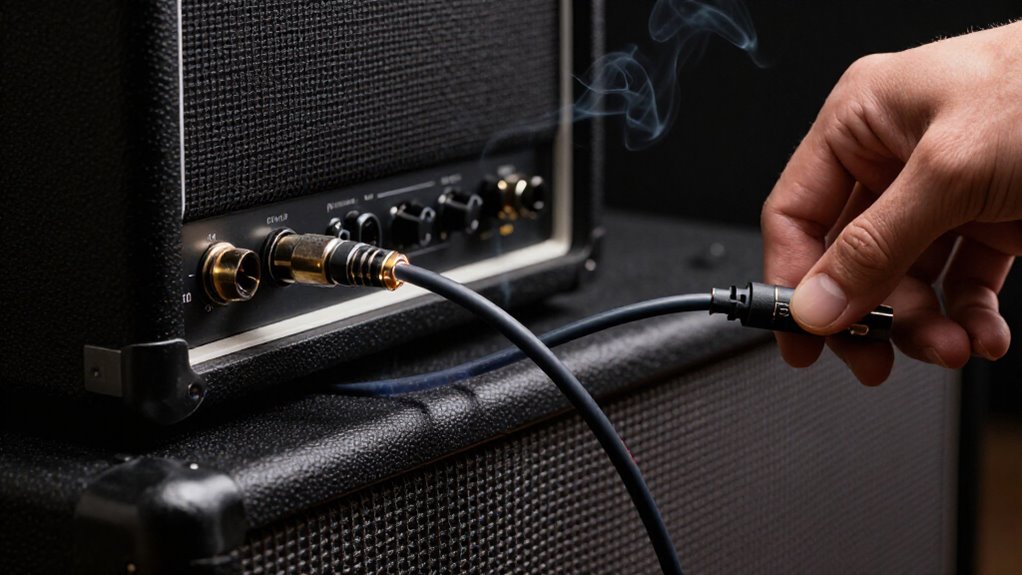
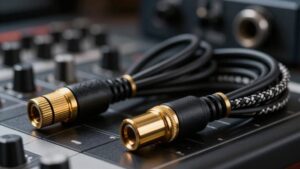
Don’t swap instrument and speaker cables: identical ¼-inch plugs hide very different designs. You use shielded, thin-core instrument cable for guitar signals, while a passive cabinet needs a heavy-gauge two-conductor speaker lead to carry amplifier current.
An instrument cable can overheat, short, or create an intermittent load that damages an amp, a tube model. Match tube-amp impedance to the cabinet, inspect jacket markings, and power down before reconnecting. The details below help you choose safely.
Shielded Core vs. Heavy-Gauge Pair
Instrument cable uses a coaxial construction: a thin center conductor carries the low-level audio signal while insulation and a braided or foil shield reject hum and radio-frequency interference. You should treat this cable as a low-level signal path, not a power link. Its 20–24 AWG center conductor prioritizes flexibility and noise rejection, but it isn’t sized for amplified current. Connecting it between an amplifier and speaker can overheat the cable, stress the amplifier, or damage equipment.
| Cable role | Safety-critical characteristic |
|---|---|
| Instrument | 20–24 AWG signal conductor |
| Speaker | 12–16 AWG current path |
| Selection | Match cable to equipment |
Lower AWG means thicker copper. Before powering your rig, inspect labels and connectors; don’t rely on appearance. Use the specified cable, keep runs undamaged, and disconnect power before rewiring.
Coaxial vs Parallel Conductors
Construction makes the functional difference clear: an instrument cable uses a coaxial layout with one insulated center conductor surrounded by a copper-braid or foil shield, while a speaker cable uses two separate parallel conductors.
In the instrument lead, the center conductor carries your low-level signal, and the surrounding shield rejects interference. That shield isn’t a second high-current path. A speaker cable instead assigns one conductor to each side of the amplifier-to-speaker circuit, creating a low-resistance path for the output. Its conductors are typically unshielded and thicker, often 12 to 16 AWG, versus roughly 20 to 24 AWG for instrument cable.
When you connect an amplifier to a speaker, use the parallel pair specified for that load. Don’t treat the coaxial shield as an equivalent return conductor; it isn’t.
High-Wattage Heat Buildup
High amplifier power can drive enough current through an instrument cable’s thin 20 to 24 AWG center conductor to generate damaging heat. As power rises and speaker impedance falls, current increases; a 360-watt amplifier driving 4 ohms can deliver about 9.5 amps. That load exceeds what a signal cable is designed to carry safely.
- Thin conductors develop higher resistance, so you can create substantial I²R heating.
- Heat can soften or melt insulation, fuse conductors, and create a short.
- A short can damage your amplifier and increase fire risk.
Use 12 to 16 AWG speaker cable between your amplifier and passive speaker. Its thicker parallel conductors lower resistance and limit heat buildup. Reserve instrument cable for low-level instrument signals; don’t rely on it for speaker outputs, even briefly, at any volume.
No-Solder Plug-and-Play Setup
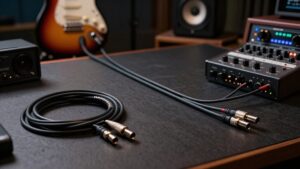
A no-solder setup works safely when you identify each cable by its intended job before connecting it. Check the jacket printing or packaging, then plug matching connectors into the correct jacks. Run an instrument cable from your guitar or bass to pedals, an amplifier input, or an audio interface.
Use a speaker cable only between an amplifier or power amp output and a passive speaker or cabinet. Identical 1/4-inch plugs don’t mean the cables are interchangeable: a thin instrument cable can’t safely carry amplifier-to-speaker current. It can overheat, fail, and potentially damage connected gear.
For powered speakers and studio monitors, use the specified signal connection, typically XLR or balanced TRS. Their amplifiers are internal, so they don’t require an external speaker cable. Disconnect power.
Tube Amp Cabinet Impedance Matching
With a tube amp, cable type alone isn’t enough: you must match the amp’s selected speaker-output impedance, typically 4, 8, or 16 ohms, to the cabinet’s rated load as the manufacturer specifies. An incorrect load can overstress output components, so you shouldn’t guess or rely on jack appearance. Turn the amp off before moving cables or selectors.
- Use a dedicated speaker cable from the speaker-output jack; an instrument cable can’t safely carry speaker-level current.
- Set the selector to the cabinet’s specified impedance, and don’t use any mismatch the manual prohibits.
- For multiple cabinets, calculate the total load: series and parallel wiring differ. If the result is uncertain, contact the manufacturer before powering on. This protects the output transformer and helps prevent dangerous no-load operation during use.
Connector Wear and Replacement Costs
Although ¼-inch plugs can look identical, speaker and instrument connectors serve different electrical demands and aren’t interchangeable. You should inspect the jacket and plug labeling before connection, because a matching plug shape doesn’t identify cable construction. Speaker leads require heavier-duty plugs and solder pads to carry amplifier-to-cabinet current safely. Instrument connectors prioritize low-noise signal transfer and may not tolerate that current; misuse can overheat conductors, damage solder joints, blow a fuse, or short and harm the amplifier.
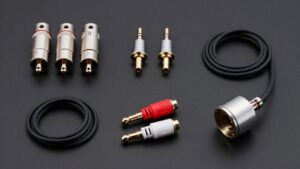
When replacing worn hardware, match the connector to the cable’s job. Use Neutrik NP2 plugs for instrument cables and Switchcraft 188 Jumbo Straight plugs for speaker cables. Speaker systems may also use locking, banana, or spade-lug connectors. Replacing a stressed connector promptly costs less than repairing an amplifier damaged by an underspecified lead.
Intermittent Speaker Load Failures
Connector replacement also prevents a more serious fault: intermittent loss of the speaker load. If you use an instrument cable between an amplifier and passive speaker, its thin center conductor and shield can overheat under speaker current, then fuse, fracture, or develop insulation damage. A damaged cable may short or open unpredictably, making the load cut in and out.
- You can expose the amplifier to a brief no-load condition.
- Some amplifiers can suffer output-stage or output-transformer damage.
- You should install rated two-conductor speaker cable, typically 12–16 AWG.
Current rises with power and lower impedance: a 360-watt amplifier driving 4 ohms delivers roughly 9.5 amps. Inspect cables for heat damage, replace suspect leads immediately, and shut down the amplifier before reconnecting speakers and restoring power.
Cable Length and Capacitance
As you lengthen an instrument cable, its capacitance rises and can roll off your guitar’s high frequencies, producing a darker tone. Use a low-capacitance, shielded instrument cable to protect the weak signal, especially on long runs. For speaker connections, account for run length and use appropriately rated speaker cable or equipment to maintain a safe, reliable load.
Length Raises Instrument Capacitance
Every additional foot of instrument cable adds capacitance, which loads a guitar’s high-impedance pickup circuit and rolls off more treble. As capacitance rises, it interacts with your pickup’s inductance and cable resistance, shifting the resonant peak downward and reducing perceived brightness. You may hear this as a darker, duller tone, especially with passive single-coil pickups and long unbuffered runs.
- Use the shortest practical instrument-cable length when high-frequency detail matters.
- Place a buffer or active pedal early if your setup requires longer cable runs.
- Don’t substitute a long speaker cable: its capacitance may muddy your signal, and its absent shielding can admit hum and radio-frequency interference.
This prevents avoidable tonal loss and helps you maintain predictable response at the amplifier input during live use.
Speaker Cable Length Considerations
For speaker connections, longer cable runs raise conductor resistance and can reduce the power your amplifier delivers to the speaker, so choose wire gauge and length together. As distance increases, select thicker conductors to limit resistance and minimize power loss between the amplifier output and speaker.
Don’t treat cable length as an isolated specification: evaluate the run, gauge, amplifier, and speaker connection as one system. Use cable designed and rated for speaker duty, and keep connections secure before applying power. Unlike instrument leads, where capacitance can affect high-frequency tone over longer runs, capacitance isn’t the primary length concern in a speaker cable. Instead, use an appropriately sized speaker cable for your run.
Passive Cabinets vs. Guitar Inputs
You must connect a passive cabinet to your amplifier’s speaker output with a speaker cable rated for amplified, high-current power. You must connect your guitar to an amp, pedal, or interface input with a shielded instrument cable that protects its weak, high-impedance signal from interference. Don’t interchange these connections or cables, because you can create noise, overheating, or equipment damage.
Passive Cabinet Power Demands
A passive cabinet draws amplified, high-current power directly from the amplifier, so it requires a proper speaker cable with two thick conductors. You must connect the amplifier’s speaker output to the cabinet with cable rated to carry the expected current and maintain a reliable load path. Thin instrument-cable conductors cannot safely handle this duty.
- Speaker cable uses low-resistance, heavy-gauge conductors for high output current.
- Instrument cable can overheat, melt insulation, and create a short circuit.
- A short may stress or damage your amplifier’s output stage.
Before powering up, inspect the connection and use only speaker cable for passive-cabinet links. Powered speakers differ because their internal amplifiers accept signal-level connections rather than external amplifier output. Match connectors and impedance before you fully energize the system.
Guitar Input Signal Levels
Although both connections may use 1/4-inch plugs, a guitar input and a passive cabinet operate at fundamentally different signal levels. Your guitar’s passive pickups produce a weak, high-impedance signal that needs a shielded instrument cable on its way to the amplifier’s input. Shielding helps keep unwanted hum and external electromagnetic interference out of that sensitive signal path.
A passive cabinet, by contrast, receives the amplifier’s far stronger, high-current output. You must use a two-conductor speaker cable rated to carry that power. Identical plugs don’t make the cables interchangeable: an instrument cable’s thin center conductor and shield can overheat, fail, or short under cabinet current, risking amplifier damage. Conversely, an unshielded speaker cable can collect noise and may dull your guitar signal over longer runs.
Cable Choice By Connection
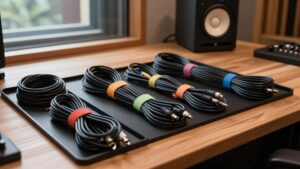
Match the cable to the connection’s electrical demands: use a two-conductor speaker cable between an amplifier or power amp and a passive cabinet, and use a shielded instrument cable from your guitar or bass to an amp input, pedal, or audio interface. Connector shape doesn’t establish suitability; many use ¼-inch plugs. Lower AWG numbers mean thicker wire, which reduces resistance and supports safe power transfer. Verify the cable before you power on the amp.
- For a passive cabinet, choose 12 to 16 AWG speaker cable; its thicker conductors handle high current.
- For a guitar input, use 20 to 24 AWG instrument cable; its shielded center conductor rejects interference.
- Never run an amp into a passive cabinet with instrument cable: thin conductors can overheat, short, and damage your amplifier.
Verify “speaker Cable” Jacket Markings
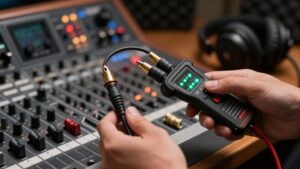
Check the cable jacket for a printed label such as “speaker cable” or “instrument cable” before connecting an amplifier to a passive speaker. Plug shape doesn’t identify construction: both types may use ¼-inch connectors. A proper speaker cable typically has two insulated conductors, commonly 12-16 AWG, designed to carry amplifier output current. An instrument cable instead uses a thin center conductor and shielding, which isn’t suitable for a passive-speaker connection.
Use gauge markings as an check; lower AWG numbers mean thicker wire. Don’t treat an “ohm” marking as proof that it’s a speaker cable, because 4- or 8-ohm values can describe a speaker load. If the jacket lacks a clear type and gauge marking, stop and confirm the cable specifications with manufacturer before use.
Conclusion
You can’t treat instrument and speaker cables as interchangeable. Use shielded, high-impedance instrument cable only between guitars, pedals, and amp inputs; use unshielded, heavy-gauge speaker cable only between power amps and cabinets. A speaker connection must carry high current without excessive resistance, heat, or intermittent opens. Match your tube amp’s output impedance to the cabinet, verify secure plugs, and read jacket markings before powering up. These checks protect transformers, output stages, speakers, and your hearing.