Cardioid vs Omnidirectional Microphone: Which Pattern Suits Your Room?
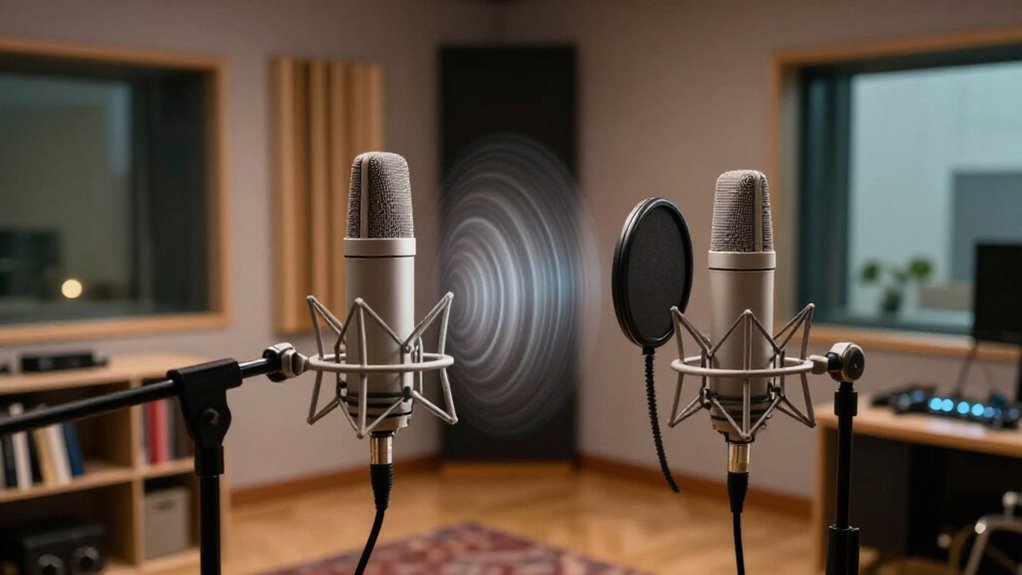
Choose a cardioid mic if you record in an untreated room: its rear rejection reduces HVAC, computer-fan, and reflected sound, improving your direct-to-room ratio. Aim it carefully, since off-axis reflections can change timbre, and use a pop filter for close speech.
Choose an omni only in a quiet, treated space when you want open, uniform pickup and no proximity-effect bass rise. The details below help you refine that choice for each setup with greater confidence.
Rear Rejection vs Room Capture
Cardioid and omnidirectional patterns differ most in how they manage reflected sound: a cardioid prioritizes the front source and can attenuate rear arrivals by up to roughly 30 dB, depending on frequency, whereas an omni responds equally in every direction. In an untreated home, you’ll usually gain clearer isolation with cardioid placement, because rearward HVAC and computer fan energy contributes less to room noise buildup. An omni captures more ambience and can sound open and natural, but it requires a quiet, treated space. To preserve a comparable direct to indirect ratio, position cardioid near 17 cm or omni near 10 cm from the source.
| Pattern | Room result |
|---|---|
| Cardioid | Rear noise control |
| Omni | Ambient capture |
| Cardioid | 17 cm balance |
| Omni | 10 cm balance |
Choose accordingly.
How Capsules Handle Off-Axis Sound
Off-axis sound reveals a capsule’s polar behavior beyond its published front response. With a cardioid, sensitivity peaks at 0°, while sound near 180° is attenuated; that rejection varies with frequency. Side and rear arrivals consequently change timbre rather than drop in level. If you aim a cardioid or supercardioid away from the source, you can capture colored spill and reflections, so alignment matters.
An omni seeks equal pickup around the capsule, giving you freer placement. Yet it isn’t perfectly uniform: at high frequencies, its pattern narrows and off-axis tone can shift. Evaluate smoothness, not only attenuation. A capsule with gradual, natural off-axis response keeps reflected sound and spill coherent; an irregular response can produce the curtain effect, making ambient arrivals sound filtered or phasey.
Close-Miking SPL Headroom
When you place a microphone within a few inches of a loud source, SPL at its diaphragm rises quickly, so its maximum input level, not only its polar pattern, sets the overload margin. Cardioid and supercardioid capsules can reach that limit sooner because proximity effect boosts low-frequency output at close range; bass transients increase peak voltage before you hear distortion. An omnidirectional capsule has no proximity effect, so moving it closer raises direct level without that low-end buildup.
Check the microphone’s maximum SPL and your preamp’s input capacity. DPA achieves high-SPL capability through a roughly 230 V pre-polarized back plate and wider diaphragm-to-back-plate spacing, permitting greater diaphragm travel before output clipping. Test-record at the loudest expected performance, watch peak meters, listen for distortion, and retain headroom.
Placement Tolerance During Setup
During setup, a cardioid usually gives you more placement latitude in an untreated room because its side and rear rejection limits added reflections and ambient noise. You can aim it slightly off-axis while retaining a direct signal, provided you keep its rear null away from the noisiest surface.
Distance still matters: moving a cardioid a few inches changes bass response through proximity effect. An omni has no such bass rise, but its equal all-direction pickup makes small moves alter direct-to-room ratio sharply. As a comparison, a cardioid at about 17 cm often matches the direct-to-indirect balance of an omni at about 10 cm.
When you reposition around stands, monitors, or HVAC paths, cardioid rejection maintains cleaner isolation; an omni captures nearer surfaces and noise.
Podcast Booths vs Concert Halls
In a podcast booth, a cardioid is usually the better starting pattern because its rear and partial side rejection reduces HVAC, computer, and nearby-room pickup while you speak at a fixed distance. It gives you stronger isolation, but its rear lobe still demands control of monitors and other noise sources behind it. At a few inches, its moderate proximity effect adds low-frequency weight and presence to your voice.
In a concert hall, use an omni when the venue sounds good and you want to preserve its natural spatial response. It captures ambience evenly, yet it also receives stage sound from every direction. In live reinforcement, feedback may build more slowly, often in the lower mids and bass, but noise pickup remains substantial. These remain.
Capsule Cleaning, Resale Value
Pattern choice preserves the intended room balance, but capsule care preserves the microphone’s calibrated response and resale condition. You protect both cardioid and omnidirectional behavior when you clean without disturbing the diaphragm or its acoustic loading.
- Use soft brush or approved tool; on clip-ons, avoid liquids and compressed air.
- Never touch the capsule, even with microfiber; residue alters frequency balance and off-axis response.
- Clean foam and grille, since dust and moisture attenuate highs and raise apparent noise.
- Reseat the grille fully so designed airflow and protective geometry remain intact.
- Store it in its original case with a windscreen, and document maintenance for buyers.
That record demonstrates controlled ownership, supports valuation, and assures users that polar consistency and treble clarity haven’t been compromised by contamination.
HVAC Noise and Mic Choice
For rooms with audible HVAC hum, a cardioid microphone usually gives you the most practical noise advantage: aim its rear null toward the vent, air handler, or reflective wall carrying the airflow noise while keeping the source on-axis. Its front-weighted response and partial side rejection reduce the steady low-frequency energy that reaches your track.
If the dominant noise arrives from the sides, choose a supercardioid when its narrower, approximately 115-degree pickup angle lets you position the side nulls effectively. An omnidirectional microphone, by contrast, captures HVAC ambience from every direction, so placement can’t create directional isolation.
In close voice work, cardioid proximity effect can add low-frequency weight, helping mask some hum, but it won’t replace correct aiming and source-to-mic distance in your recording chain.
Pop Filter Needs Compared
With a cardioid mic, you can place a pop filter between your mouth and capsule, work a few inches back, and use slight off-axis positioning to suppress plosives while retaining moderate proximity warmth.
An omnidirectional mic has no proximity effect, so you should prioritize airflow damping rather than distance-based bass shaping. Because omni captures more room energy, its pop filter often matters more for keeping low-frequency plosive bursts from dominating the open recording.
Cardioid Pop Filter Requirements
Although a cardioid microphone rejects much of the off-axis sound, it doesn’t stop the direct bursts of air produced by close-spoken /p/ and /b/ sounds. A filter remains valuable when you work close to the capsule, where proximity effect raises low-frequency energy and exaggerates plosive impact. Place the screen between your mouth and the diaphragm, with enough spacing to diffuse airflow rather than create turbulence. You’ll get the most reliable control when you:
- Align the filter with the capsule’s front axis.
- Keep a practical air gap between mouth and screen.
- Maintain screen-to-capsule spacing for airflow diffusion.
- Speak slightly across the diaphragm, not directly into it.
- Monitor low-frequency bursts and adjust distance as needed.
This placement addresses airflow mechanically; polar rejection alone can’t protect diaphragm.
Omnidirectional Plosive Control
An omnidirectional microphone needs more deliberate plosive control because its capsule responds to pressure changes from every direction, including airflow that wraps around the front of the mic. Unlike a cardioid, an omni offers no side or rear rejection to attenuate off-axis mouth bursts. Fit a proper pop filter and place the capsule slightly off-axis, so your breath doesn’t drive a low-frequency pressure pulse directly into its diaphragm.
Small changes in head position or speaking angle can redirect airflow toward the capsule, so maintain consistent technique. An omni has no proximity effect; moving closer won’t add bass weight that might conceal a pop. In a busy room, its broad air and room capture can spread plosive energy across the recording, making repair less predictable.
Street Interviews in Wind
Wind protection comes first: fit a foam windscreen or furry cover before choosing a polar pattern. You’ll find an omnidirectional mic handles interviewer movement more consistently, but it captures wind and street ambience from all directions.
Aim a cardioid’s 0° front axis at the talker to use its roughly 130° pickup field and rear attenuation to reduce off-axis street noise.
Wind Protection Comes First
For street interviews in windy conditions, put physical wind protection ahead of polar-pattern choice: use a foam windscreen at minimum, and add a furry wind cover when gusts create low-frequency turbulence at the capsule. Neither cardioid nor omnidirectional response prevents pressure fluctuations from modulating the diaphragm.
- Fit the foam closely; gaps admit turbulent airflow.
- Use a furry cover to diffuse gust energy before it reaches the grille.
- Keep the microphone stable; cable contact and grip changes create handling noise.
- Aim a cardioid’s front axis at the talker; rear rejection only attenuates sound behind.
- Shield omni capsules especially carefully because they admit environmental sound from every direction.
Even supercardioid and hypercardioid designs require shielding, since polar directivity cannot remove wind-induced infrasonic energy or mechanical overload.
Omni Handles Movement Better
Because an omnidirectional capsule maintains uniformly sensitivity around its axis, it keeps a moving interviewee’s voice more consistent as they turn, sway, or shift position in the wind.
You don’t need to preserve a narrow on-axis relationship as the speaker rotates or leans. An omni receives comparable direct-sound energy across those angular changes, so its level remains steadier at a given distance. Its pressure-operated response also has no proximity effect, avoiding the low-frequency buildup and tonal shifts that close, unpredictable movement can produce with directional capsules.
A cardioid’s roughly 130-degree frontal acceptance region demands tighter aiming; off-axis turns reduce its direct pickup. For windy street interviews, hold the protected omni near the talker and let natural body motion preserve a stable direct-to-ambient balance overall.
Cardioid Cuts Street Noise
A cardioid microphone improves street-interview clarity by prioritizing the talker within its roughly 130° front pickup region while attenuating off-axis traffic, passersby, and reflected ambient sound. You gain a stronger direct-to-ambient ratio than with an omni, which receives all directions equally.
- Aim the front lobe at the mouth to maximize speech level.
- Place traffic and crowds behind the capsule, where rejection can approach 30 dB frequency-dependently.
- Use a windscreen; directionality doesn’t eliminate turbulence-induced low-frequency rumble.
- Work close for SNR, but control plosives and moderate proximity-effect bass.
- Keep the speaker on-axis as hard pavement reflections still enter the front lobe.
This geometry won’t silence a street, but it makes the desired voice dominate the recorded field and reduces later cleanup demands during postproduction editing work.
Monitor Wedges Favor Cardioids
Monitor wedges generally favor a cardioid vocal mic: its maximum on-axis sensitivity faces the performer while its rear and side rejection reduce monitor spill and raise the gain-before-feedback margin compared with an omnidirectional pattern.
You can aim the cardioid’s 0° axis at your voice and place wedges in less-sensitive regions, limiting direct monitor energy and reflected stage sound at the capsule. This front-focused response keeps bleed from dominating your vocal channel and lets you run higher level before the feedback loop closes.
Don’t treat cardioid rejection as absolute, however. Most cardioids retain a rear lobe, so a wedge directly behind the microphone can still leak into the signal. Angle and distance matter: aim the wedge toward a rejection null and verify gain at performance volume. In noisy setups, start with cardioid.
Conclusion
Choose cardioid when you need rear rejection, higher gain before feedback, and tighter isolation from HVAC, wedges, and untreated reflections. You’ll trade that control for greater placement sensitivity, proximity effect, and less forgiving off-axis coloration.
Choose omnidirectional when your room sounds balanced, your source moves, or you need natural low-frequency response and uniform off-axis capture. It won’t reject noise or monitors, so improve room acoustics, reduce ambient levels, and use wind protection outdoors when needed.