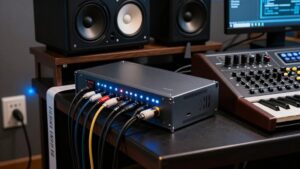
Active vs Passive DI Box: Which One Your Instrument Needs
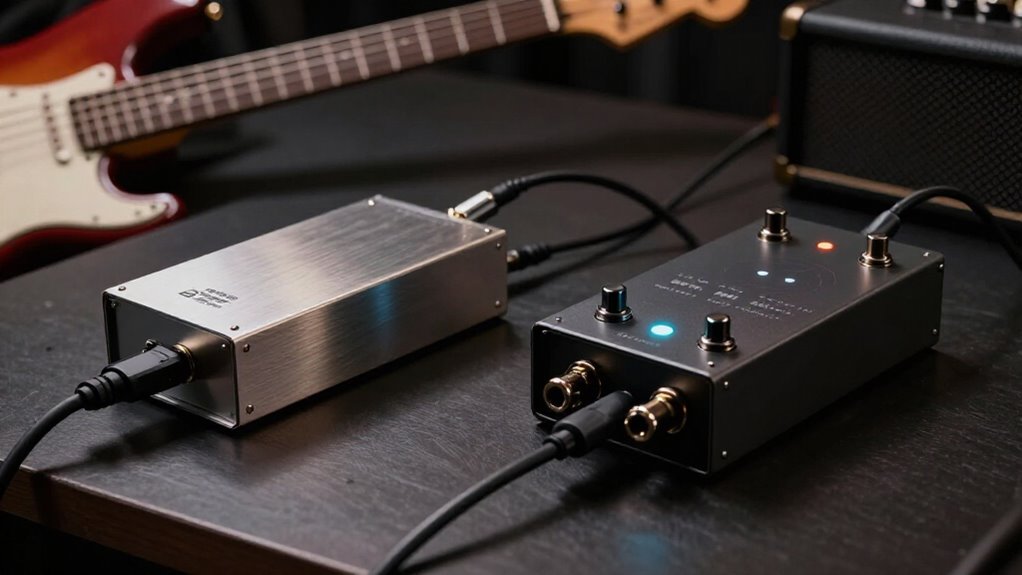
Choose a passive DI when you’re connecting a keyboard or strong line-level output: its transformer balances the signal, isolates grounds, and needs no power.
Choose an active DI for passive guitar, bass, or piezo pickups, because its high-impedance buffer prevents loading, treble loss, and weak transients.
For piezos, target about 10 MΩ input impedance.
Check active-DI batteries or phantom power before setup; use ground lift to cure hum.
The details below help you optimize each connection.
Transformer Isolation vs Powered Gain
Passive and active DI boxes solve the same interface problem through different signal paths. A passive unit routes your signal through a transformer, balancing it while blocking DC and breaking the direct ground path between instrument and preamp. This isolation reduces hum caused by unequal reference voltages.
| Path | Signal action | Result |
|---|---|---|
| Passive transformer | Blocks DC, isolates grounds | Reduced loop hum |
| Active amplifier | Adds buffered gain | Controlled headroom |
An active DI uses a powered buffer to maintain level over long cable runs. When its battery starves, the gain stage distorts audibly; phantom power avoids batteries, but you must manage Pin-1 grounding. Choose transformer saturation for vintage coloration, or active circuitry for transparent, low-noise transfer with predictable headroom during demanding transient peaks at the preamp input.
Input Impedance and Signal Loading
Beyond isolation and gain, input impedance determines how heavily the DI loads your instrument: the pickup sees the DI input as part of its circuit, so an impedance that’s too low can reduce level, soften transient punch, and alter high-frequency response. With a passive DI, the transformer establishes that load. Legacy designs around 600-ohm assumptions can present a restrictive input, changing a low-output pickup’s transfer, resonance, and feel.
Modern transformer DIs, including designs rated near 130,000 ohms, impose less loading and preserve dynamics. An active DI uses a unity-gain buffer to decouple your instrument from the downstream input, maintaining level when the source is vulnerable to loading. Match high-impedance passive pickups to a high-Z or buffered input; otherwise, loading can attenuate frequencies before conversion.
Noise Rejection on Long Runs
On a long stage run, a DI converts your unbalanced, high-impedance instrument signal to a balanced, low-impedance XLR feed, which rejects much of the electromagnetic interference and hum that cable runs can collect.
That conversion lets you run longer distances without carrying a fragile, noise-prone unbalanced signal across the stage. A passive DI adds transformer isolation, so it can interrupt ground-path reference differences that produce loop hum. If transformer loading reduces your output or softens transient punch, use an active DI: its buffer preserves level and bandwidth before the balanced run. For piezo pickups, select an active input near 10 megohms; lower loading prevents high-frequency squawk from contaminating the feed. Phantom-powered active units may aggravate ground loops, so engage a ground lift when needed.
Battery Checks and Setup Speed
An active DI needs a power check before the show: a weakening battery can produce rising distortion or reduced headroom mid-set. Replace questionable batteries before line check, or use +48 V phantom if supported. Listen as you route phantom: a ground-loop hum may require ground-lift. On some designs, lifting pin 1 also interrupts phantom power, shutting the DI down. Verify output and noise after every lift setting.
Speed setup with a fixed checklist: confirm battery condition or phantom presence, verify ground-lift position, then set pad and level controls. A phantom-powered design such as a J48 uses a switching supply to convert phantom DC into internal AC, preserving headroom without losing power when you lift ground. This sequence prevents gain and noise troubleshooting during soundcheck.
Keyboard Outputs Suit Passive DIs
Keyboards usually pair well with passive DIs because their active, line-level outputs can drive a transformer without needing additional gain or power. You can route a keyboard’s unbalanced output into the DI, which converts it to a balanced, mic-level signal for console runs. The transformer needs no battery, blocks DC, and provides impedance matching that suits a strong source.
If you push output levels, transformer saturation may add gentle compression and harmonic color. That character can complement pads, electric pianos, or synth leads without compromising routing. Set the keyboard’s output conservatively to avoid clipping the DI or mixer preamp.
If hum appears, engage the DI’s ground-lift switch. Passive loading matters more with weak pickups; your keyboard supplies enough voltage to preserve level and bandwidth.
Transformer Resale Value Over Time
Beyond keyboard compatibility, a passive DI’s transformer can retain real resale value over time. Because its impedance-matching circuit has no battery or active electronics, you aren’t pricing in a consumable power system or a likely electronic failure point. A quality Jensen-based transformer remains useful if it maintains predictable level, frequency response, and isolation across acoustic guitar, active and passive bass, and keyboard loads.
Its construction, core material, laminations, Faraday shielding, and mu-metal encapsulation, also creates manufacture-specific performance that buyers recognize. You can expect steadier demand from touring users because passive operation avoids battery starvation distortion and phantom-power complications. Lesser transformers may meet paper specifications yet shift response under real source impedances, making their resale less defensible. That consistency gives you a clearer basis for long-term valuation.
Passive Transformers Can Saturate
At high input levels, a passive DI’s transformer can saturate as its magnetic core approaches its flux limit. Saturation is nonlinear: as the core runs out of magnetic capacity, it adds harmonic distortion and can compress peaks instead of passing them transparently. You may hear harshness, reduced transient clarity, or level-dependent breakup on a strong instrument or line-level source.
Transformer behavior depends on core material, laminations, winding geometry, shielding, and impedance ratio. Older designs or poor loading can drive saturation sooner, especially when the source doesn’t see a suitably high primary impedance. If your passive DI changes tone as you play harder, try a properly matched transformer model or an active DI with greater headroom. That choice can preserve cleaner dynamics at high levels.
Ground-Lift Switches Stop Hum
If you hear 50/60 Hz hum, engage the DI’s ground-lift switch to disconnect XLR pin 1 and break the ground loop. This isolates conflicting ground paths between your instrument rig, mixer, monitors, and PA without changing signal level. If hum remains, verify that lifting ground hasn’t interrupted phantom power on your active DI.
Breaking Ground Loops
Ground-loop hum occurs when your instrument rig and mixer share more than one ground path, allowing small voltage differences to circulate as audible 50/60 Hz buzz. Many DI boxes include a pin-1 ground lift that disconnects the XLR shield/reference path, removing the circulating current while preserving the balanced audio signal. Passive DIs add transformer-based galvanic isolation: audio crosses magnetically, but DC and chassis-potential differences do not.
With active DIs, pin-1 lifting may interrupt phantom-power return in certain circuits. Choose a design that isolates audio ground while maintaining its 48 V supply, such as a switched-power implementation. Keep the DI near your source to minimize unbalanced cable exposure. Treat hum as a wiring-reference fault, not tonal correction. If noise remains, polarity inversion can alter coupling.
Using Ground-Lift Switches
The ground-lift switch gives you a direct way to interrupt the hum path identified in a ground loop: it separates the DI’s internal audio ground from XLR pin 1, so DC offsets or reference-voltage differences between your instrument rig and the mixer can’t circulate as noise.
Use it when buzz appears after you connect to a mixer or PA, particularly with shared power or long cable runs. The DI still converts your unbalanced quarter-inch output to low-impedance, balanced XLR signal.
- Start with ground connected; lift only if hum remains.
- Keep the balanced output active and properly referenced.
- Transformer isolation further blocks loop current and interference.
- Check phantom behavior; some active DIs lose power.
- Choose designs that lift audio ground without interrupting phantom power.
Piezo Pickups Need Active Inputs
If your acoustic guitar uses a piezo pickup, connect it to an active DI or preamp with an ultra-high-impedance input, typically around 10 MΩ. This prevents pickup loading that causes treble loss, level drop, and harsh “squawk” in the signal.
Match the DI’s input impedance and power supply to your pickup so its transients stay controlled through long cable runs.
Piezo Impedance Requirements
Piezo pickups demand a very high input impedance, typically about 10 MΩ, because their reactive elements lose high-frequency extension and develop harsh resonant peaks when a lower-impedance input loads them.
When you connect an acoustic instrument, treat 10 MΩ as the target load. This preserves voltage transfer, bandwidth, transients, and low-mid detail. Check DI specifications:
- Input impedance: approximately 10 MΩ.
- Source type: piezo or undersaddle transducer.
- Frequency response: no premature treble roll-off.
- Resonance control: reduced “squawk” peaks.
- Dynamic behavior: intact attack and detail.
Transformer-loaded passive DIs generally can’t present this condition. Lower impedance can make your pickup sound thin, harsh, and uneven. Match the interface to the transducer’s electrical requirements for a natural, stable direct signal and preserve full bandwidth and dynamics at the DI output.
Why Active Inputs Matter
Because a piezo pickup behaves as a reactive capacitive source, it needs an active DI input around 10 MΩ to avoid immediate loading effects. The powered input buffer presents the piezo with sufficient impedance, preventing the DI from drawing signal current that alters its voltage and frequency behavior. You retain output level, extended high-frequency response, and the transient information that defines acoustic attack. Proper loading also smooths sharp peaks without stripping detail.
A passive transformer DI generally can’t provide this impedance; so the mismatch changes your sound before it reaches console gain or EQ. You may hear reduced level plus a response that is simultaneously duller and brittle, often described as piezo squawk. Always choose an active DI with a specified 10 MΩ input.
Matching Preamps and Pickups
Matching starts at the pickup’s output stage: a low-output, unbuffered piezo needs an active DI with an input impedance around 10 MΩ. That high-Z buffer lets you retain level, transient punch, and extended frequency response without loading the element into squawk or thinness.
- Choose active/high-Z DI for passive piezo systems.
- Expect roughly 10 MΩ input impedance.
- Use its buffer to preserve dynamics.
- Supply phantom or battery power as required.
- Choose passive transformer DI for buffered, active pickups.
If your acoustic has an onboard preamp, its stronger low-impedance output tolerates transformer loading better. You can use a passive DI confidently, provided gain staging remains. Match the DI to what the pickup delivers, not to the instrument type; electrical loading determines whether console receives the signal.
Match DI to Output Level
Your instrument’s output level should drive the DI choice: a low-output pickup benefits from an active DI’s powered buffer, while a strong, line-like source usually drives a passive transformer DI cleanly.
Choose passive when your active pickups or keyboard deliver enough voltage to overcome transformer loading without level or punch loss. Check input impedance, not just the label: legacy 600-ohm transformer inputs can alter a bass or guitar’s tone and feel, whereas modern passive DIs may specify roughly 130 kilohms. If a passive DI produces weak or degraded audio, your source isn’t driving it effectively; switch to an active DI. For piezo transducers, use an active DI with about 10 megohms input impedance. That high impedance preserves level, smooths peaks, and prevents squawk.
Conclusion
Choose the DI that preserves your instrument’s source signal without loading, clipping, or adding noise. You’ll usually use a passive DI with high-output keyboards and line-level devices, where transformer isolation and headroom matter. You’ll choose an active DI for passive guitars, basses, and piezo pickups that need high input impedance and gain.
Check battery status, engage ground lift only when hum occurs, and consider cable length, output level, and transformer saturation before you connect everything.