
TRS vs TS Cable: Which Cable Goes Where in Your Studio?
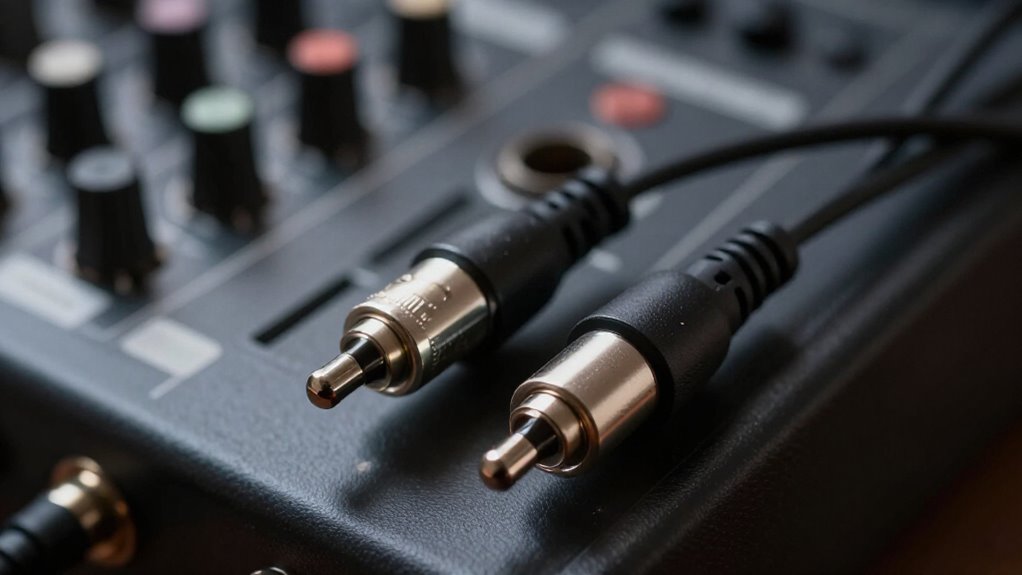
Use TS cables for your unbalanced mono sources, such as guitars, basses, pedals, and designated consumer outputs. Use TRS cables between devices whose outputs and inputs both support balanced operation, especially for longer studio runs, or for stereo headphone connections.
Don’t assume a quarter-inch jack is automatically balanced; check its labels and manual. Use manufacturer-wired TRS insert Y-cables only for insert points. Patch bays favor balanced TRS wiring. Next, you’ll see pinouts shape routing.
TS Two Conductors, TRS Three
The key difference is conductor count: a TS plug has two sections, tip and sleeve, while a TRS plug has three, tip, ring, and sleeve. This physical distinction determines how many separate electrical paths your cable can support. You can’t identify the wiring scheme from plug diameter alone: both formats come in ¼-inch (6.35 mm) and 3.5 mm versions.
| Plug type | Conductive sections | Available sizes |
|---|---|---|
| TS | Two | ¼-inch, 3.5 mm |
| TRS | Three | ¼-inch, 3.5 mm |
When you choose a cable, count the insulating bands and match the connector format to the equipment jack. A TS plug has one band; a TRS plug has two. That quick inspection prevents incompatible connections and helps you select the correct cable before patching your studio gear with confidence during routine setup work.
Tip, Ring, Sleeve Functions
Tip, Ring, Sleeve Functions
Connector sections assign distinct electrical roles: the tip carries the signal on a TS cable or one signal leg on a TRS cable, while the ring on a TRS plug carries the second balanced leg or the right channel in stereo wiring. The sleeve, at the rear of either plug, commonly serves as ground or the shared return path. On a TS connector, you use only tip and sleeve, so the tip handles the audio signal and the sleeve completes its return path.
On a TRS connector, the ring adds a separate conductive path. It’ll carry the second leg of balanced mono or the right channel of an unbalanced stereo feed. Check that every plug section contacts its cable conductor and jack terminal correctly.
Noise Rejection Over Long Runs
For long cable runs, a balanced TRS connection resists interference by carrying the audio on two conductors plus a shield. Because each conductor carries opposite-polarity versions of the signal, the receiving input cancels noise induced along the path.
Use balanced cabling only when both devices support balanced input and output; a TRS plug by itself doesn’t create noise rejection.
- Run TRS-to-TRS between compatible balanced rack gear across the room.
- Choose TRS-to-XLR for monitor connections when the speaker input uses XLR.
- Avoid long TS runs near power supplies, dimmers, or mains cables; its single signal conductor and ground return pick up more interference.
If you hear hum or buzz, verify the equipment’s balanced I/O specifications before replacing cables. Keep audio leads separated from AC wiring.
Soldering Difficulty for Custom Leads
TS leads are usually easier to solder because you connect the tip to the signal conductor and the sleeve to ground. Strip the insulation cleanly, tin the conductors, and make a secure joint before closing the plug.
TRS connectors demand more precision because you must wire three contacts without bridging adjacent terminals. For balanced wiring, connect tip to hot, ring to cold, and sleeve to the shield. For stereo wiring, tip carries left, ring carries right, and sleeve provides common ground. Confirm the intended signal type and the equipment’s pinout first.
Keep exposed wire short, use heat control, and test continuity between every contact. Verify there are no shorts or swapped connections before you install the lead in your studio equipment or signal chain.
Headphone Outputs Need TRS
Stereo headphone outputs require a TRS connection to deliver both channels: the tip carries left audio, the ring carries right audio, and the sleeve provides their shared ground.
When you connect stereo headphones, use a TRS plug, cable, or correctly wired adapter at a compatible output. A TS plug has only tip and sleeve, so it can’t carry separate left and right channels. Size doesn’t identify function: 3.5 mm and quarter-inch plugs may carry different signal formats.
- You hear panned instruments and stereo effects in their intended positions.
- You avoid losing a channel when monitoring a mix.
- You identify TRRS headset plugs, which add a microphone contact.
Check your headphones’ connector and adapter wiring before recording, so both channels reach ears intact during sessions.
Connector Plating and Oxidation
Gold-plated TRS and TS plugs resist corrosion better than nickel-plated versions, but gold doesn’t improve audio quality when both connectors make clean contact. Nickel plating remains durable and common, so don’t treat gold as an automatic upgrade. What matters is a stable, low-resistance connection between the plug and jack.
Check plug surfaces regularly. Oxidation, skin oils, dust, or grime can raise contact resistance on either plating, producing crackling, dropouts, or intermittent sound when you move the cable. Keep connectors clean and dry, using a non-abrasive contact cleaner and a lint-free cloth. Don’t scrub with abrasive pads or compounds, because they can remove plating. If you see corrosion, pitting, or peeling metal, replace the cable. You can’t judge a connector’s condition by plating color.
TRS Inserts Can Misroute Signals
An insert jack uses a TRS connector differently from a balanced audio jack: it carries an unbalanced send on one conductor and a return on the other. You need an insert Y-cable, whose TRS plug feeds two separate TS plugs. Connecting that Y-cable to a balanced TRS input or output misroutes audio, because its tip and ring represent opposite legs of one balanced mono signal, not independent paths.
- Tip usually sends the mixer channel to your compressor or effects unit.
- Ring usually returns the processed signal, although some equipment reverses this wiring.
- A TRS-to-TRS lead won’t replace the Y-cable or create separate send and return connections.
Check the jack label and manual before patching. Use the manufacturer-specified insert wiring; otherwise you may lose signal.
TS Cables Cost Less
TS cables usually cost less because their two-conductor design uses fewer materials and components than TRS cables. For a short, compatible unbalanced mono connection, such as a guitar-to-pedal run, you can save money without sacrificing function. Compare cables with the same length and build quality, and don’t trade reliable shielding or connectors for the lowest price.
Simpler Design, Lower Price
With only a tip and sleeve conductor, a TS cable carries one mono signal plus ground, so it uses less material and simpler wiring than a three-conductor TRS cable. This two-conductor layout reduces complexity: fewer conductors, termination points, and less copper and insulation. When your gear uses TS jacks, you can buy a dependable cable without paying for an extra ring conductor that serves no function. Think of practical difference:
- A guitar reaches a stompbox through a single signal conductor.
- A bass plugs into an amplifier with a two-contact connector.
- A short patch needs tip, sleeve, shielding, and strain relief.
Lower price reflects the reduced build, not reduced suitability. Check your jack specification before buying; TS doesn’t replace TRS when equipment requires TRS wiring.
Budget-Friendly Unbalanced Connections
For short, unbalanced instrument runs, TS cables give you the lowest-cost practical connection between guitars, basses, keyboards, pedals, and amplifiers. Their two-conductor Tip-Sleeve design carries a mono signal on the tip and uses the sleeve as ground, making them appropriate when both devices provide unbalanced connections. You can use TS leads for a guitar-to-pedal chain, pedal-to-amp link, or compatible keyboard output without paying for balanced cabling you can’t use.
Keep each run as short as your layout allows, because unbalanced wiring picks up hum and electromagnetic interference more readily than balanced TRS wiring. Select cables with effective shielding, durable plugs, and reliable strain relief. Use balanced TRS for longer runs when your equipment supports it. This substantially reduces induced noise in demanding studio layouts.
Patch Bays Favor TRS
You’ll typically use ¼-inch TRS patch cables to preserve balanced routing through a patch bay and its normalled connections. This helps reject noise across longer studio cable paths, but only when both connected jacks support balanced operation. Check every patch bay and device specification, and use TS only for designated unbalanced mono paths.
Balanced Patch Bay Routing
When your patch bay and connected equipment support balanced operation, use ¼-inch TRS cables for its patch connections. Their tip carries the hot signal, the ring carries the cold signal, and the sleeve provides shielding and ground. This arrangement preserves the balanced path between compatible devices.
- Route a balanced preamp output to a balanced interface input with TRS patch leads.
- Keep hot and cold conductors intact through each patch point to maintain common-mode noise rejection.
- Choose TS only for explicitly unbalanced outputs, inputs, or bay circuits.
Before patching, verify that both connected devices and the bay’s wiring support balanced operation; a TRS jack alone doesn’t guarantee it. Across longer runs, balanced routing reduces interference pickup and keeps your studio signals cleaner.
Normalled Connections And TRS
Balanced patch bays favor ¼-inch TRS connections because one cable preserves the hot, cold, and shield conductors between compatible devices. In a normalled bay, the rear output and input are internally linked, so your signal follows its default path without a front-panel patch cable. When you insert a TRS plug, it may break that route, or it may leave the source feeding both destinations. The result depends on whether you’ve configured the pair as full-normal, half-normal, or through.
For balanced paths, tip carries hot, ring carries the inverted leg, and sleeve provides shield/ground. Before you patch equipment, check the bay’s manual for its normalization behavior and rear-panel wiring scheme. Use TRS patch leads wherever the connected balanced I/O supports them, so you preserve intended routing.
Avoiding Unbalanced Signal Issues
Because TS cables carry an unbalanced signal on two conductors, they can pick up hum, RF interference, and ground-related noise over longer runs. Patch bays often add routing connections, increasing those risks. TRS bays favor balanced mono connections: the receiving input compares hot and cold conductors, rejecting noise they collect equally.
- You patch a balanced preamp output to a compressor without adding noticeable buzz.
- You reroute line-level hardware while preserving clean gain staging and signal integrity.
- You keep unbalanced synths, pedals, and consumer outputs on short TS leads.
Use TRS patch cables only when both the bay and connected equipment provide balanced I/O. A TRS plug doesn’t balance an unbalanced output. For unbalanced gear, use short runs away from nearby power supplies and transformers.
Consult Each Device Manual
Consult each device’s manual before choosing a ¼-inch cable, since the same jack size may carry unbalanced mono TS, balanced mono TRS, or stereo TRS signals. Check the manual and jack-panel markings for “balanced,” “TRS,” “unbalanced,” “TS,” “line out,” or “stereo.” These labels identify intended wiring and prevent incorrect routing.
For studio monitors, follow your interface’s specified output format, which is often ¼-inch TRS. Use a compatible TRS-to-TRS or TRS-to-XLR lead, depending on the monitor input. Use TS cables for guitars, basses, and many pedals when their documentation specifies unbalanced instrument connections. Don’t assume every TRS jack is balanced: it may instead carry left and right stereo channels. If instructions remain unclear, consult the manufacturer’s support pages before connecting, especially stereo outputs or balanced inputs.
Conclusion
Choose TS when you carry a single unbalanced mono signal between short-run instruments, pedals, and amp inputs. Choose TRS when your device requires balanced mono, stereo headphones, or insert connections. You’ll reduce hum on long balanced runs by using TRS with compatible balanced outputs and inputs. Don’t assume every TRS jack carries stereo; check the manual and connector wiring. Label custom leads, test insert cables, and use your patch bay’s format to prevent routing errors.