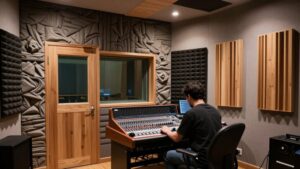
Acoustic Foam vs Acoustic Panels: What Actually Absorbs Sound Better?
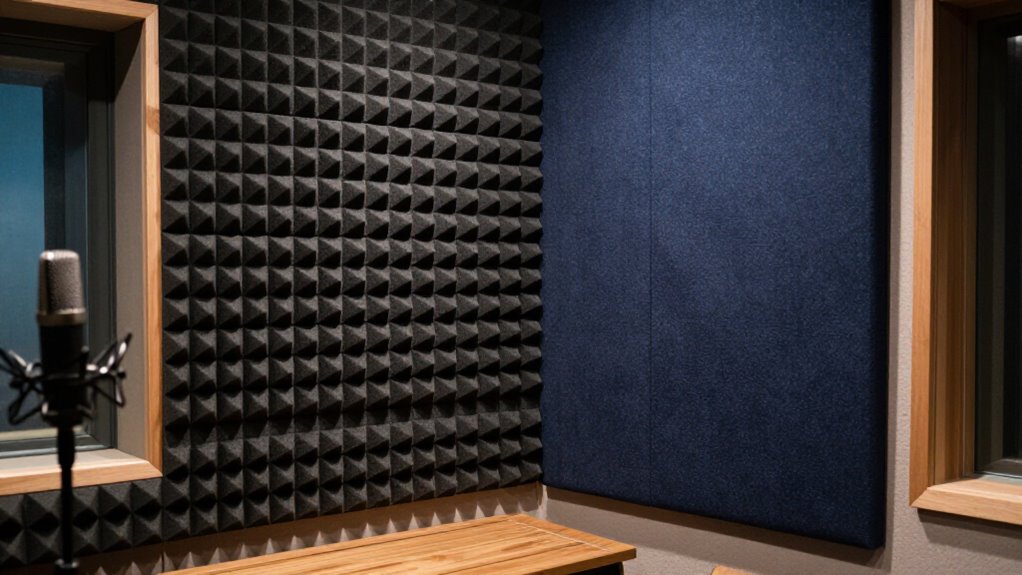
Fabric-wrapped acoustic panels with dense fiberglass or mineral-wool cores usually absorb sound better than acoustic foam because they work evenly across the speech range and midrange frequencies.
Two-inch foam controls reflections above 2 to 3 kHz, while four-inch foam reaches 1 kHz. Compare octave-band data at 250 Hz rather than relying only on NRC.
Use foam for high-frequency control; choose panels when you need broader treatment. The mounting, durability, and room-use details below help you choose.
Thickness and Density Comparison
Thickness and density determine how effectively a treatment absorbs different frequencies. You should match both variables to the frequency range you need to control. A 2-inch foam treatment mainly targets frequencies above 2 to 3 kHz; increasing it to 4 inches extends useful absorption toward 1 kHz. However, speech fundamentals commonly occupy 100 to 200 Hz, so neither thickness reliably controls the lowest vocal energy.
| Treatment | Thickness | Practical absorption range |
|---|---|---|
| Foam | 2 in. | Above 2 to 3 kHz |
| Foam | 4 in. | Toward 1 kHz |
| Fabrisorb panel | 1 in. | Effective at 500 Hz |
| Fabrisorb panel | 2 in. | Significant to 250 Hz |
Dense panels broaden overall performance: 1-inch Fabrisorb works well at 500 Hz, whereas 2 inches reaches significant absorption near 250 Hz. Increasing thickness improves low-frequency control, but construction governs results.
Open-Cell Foam and Fiberglass Cores
Open-cell polyurethane foam dissipates sound as waves move through its interconnected pores, but its absorption depends strongly on material thickness. A two-inch layer primarily attenuates higher frequencies above roughly 2–3 kHz, whereas four-inch foam extends useful absorption to about 1 kHz. You should so treat thin foam as a high-frequency treatment, not an all-encompassing voice-control solution.
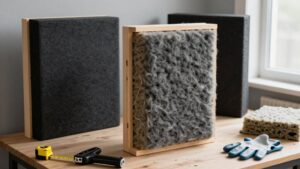
Fiberglass panels use dense, porous cores behind acoustically transparent fabric, allowing them to absorb across a broader band than typical thin foam. A 1-inch Fabrisorb panel remains relatively effective near 500 Hz, while a 2-inch panel can absorb sound energy down to 250 Hz. Since voice fundamentals fall between 100 and 200 Hz, you must account for thickness and placement before expecting either product to control low-frequency speech.
NRC Ratings by Frequency
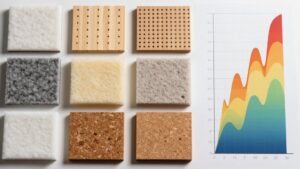
An NRC rating gives you only a broad average of absorption at 250, 500, 1,000, and 2,000 Hz; it can’t reveal where a foam or panel actually performs well. You should examine octave-band coefficients, particularly at 250 Hz and below, when low-frequency control affects your room. The averaged number can conceal sharply different absorption profiles.
At equal thickness and mounting, supplied results show why: 2-inch foam concentrates absorption above roughly 2–3 kHz, whereas 4-inch foam reaches about 1 kHz. A 1-inch Fabrisorb panel remains relatively effective at 500 Hz; its 2-inch version absorbs significant sound down to 250 Hz.
Match thickness and installation before comparing curves, because material and mounting conditions change frequency-specific performance. That comparison tells you what frequencies each treatment targets.
Adhesive Mounting Versus Z-Clips
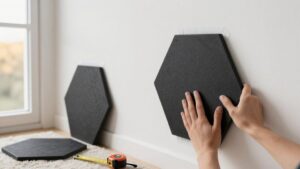
Mount the treatment in a way that suits its weight and your wall construction after you’ve matched its absorption curve to the room’s needs. Adhesive provides a simple, low-profile mounting method for lightweight foam on compatible walls. Verify the adhesive’s load rating, surface preparation requirements, and bond compatibility before installation.
Use Z-clips for heavier fabric-wrapped panels when you need a mechanical connection. Their interlocking halves hold panels flush while letting you lift them off for repositioning or service. You must fasten clips into suitable wall structure, not rely on weak substrate alone. Adhesive removal can leave residue or pull paint or drywall facing; Z-clips leave screw holes but usually enable cleaner panel removal. Neither choice changes absorption: material, thickness, and placement determine acoustic performance.
Humid Rooms and Rental Walls
Humidity and lease restrictions can determine whether acoustic foam or panels remain practical after installation. In humid rooms, review each manufacturer’s moisture and mold guidance before installation; no general humidity rating applies here. Don’t paint acoustic foam: coating can clog its pores and reduce absorption, while moisture can complicate upkeep.
For rental walls, lightweight foam usually works with tape or removable adhesive. Test a small, hidden area first to limit surface damage.
Panels weigh more and commonly require brackets or keyhole mounts, so verify that your lease permits the method and that the wall can support it. Neither option soundproofs a room; both absorb sound. If wall protection matters, prioritize a removable system that meets your absorption target and mounting constraints and deposit protection.
Foam Replacement and Fabric Cleaning
Inspect acoustic foam periodically and replace it when it crumbles, sustains damage, or no longer stays securely attached, as deteriorated material can shed particles and create uneven absorption coverage. Choose replacement thickness according to your frequency target: 2-inch foam primarily absorbs above 2–3 kHz, whereas 4-inch foam reaches approximately 1 kHz. Don’t paint foam; paint blocks pores and reduces absorptive performance.
For fabric-wrapped panels, follow the manufacturer’s care instructions and test each cleaning method on a small, inconspicuous area first. Use a vacuum’s upholstery attachment with gentle passes to remove surface dust. Avoid soaking the fabric, because moisture can enter and wet the acoustical core. Maintain replacement coverage across the treated area so your absorption remains spatially consistent and predictable over time in service.
Fire Ratings and Off-Gassing
Beyond maintenance, verify fire performance and emissions before selecting or installing acoustic treatment.
- Check the exact product’s fire-test documentation against applicable building-code requirements; don’t assume any foam or panel qualifies. Documentation should identify the tested configuration, because substitutions or site conditions may change documented compliance.
- Treat acoustic foam as potentially combustible unless its documented rating suits the intended occupancy, particularly public or commercial spaces.
- Evaluate fabric-wrapped panels as complete assemblies: fabric, core, and backing each can alter fire performance.
- Request product-specific emissions data when indoor air quality matters, then air out newly installed treatment as directed and follow handling and installation instructions. Use manufacturer guidance for ventilation periods and avoid treating generic marketing claims as emissions evidence for your project.
Impact Resistance and Edge Damage
When you place acoustic foam in exposed locations, its soft porous edges can dent, tear, or crumble under abrasion and minor impacts. Rigid, fabric-covered panels typically retain their shape better because their dense cores and frames protect the absorptive material. However, neither option is impact-proof, so you should use secure mounting and keep treatments clear of traffic paths.
Foam’s Vulnerable Edges
Although acoustic foam installs quickly with adhesive or tape, its lightweight, porous structure leaves exposed edges prone to dents, tears, and crumbling. Any cut you make to fit a corner, outlet, or ceiling boundary removes the factory edge and increases handling sensitivity. During installation, compression from your fingers, a tool, or misaligned placement can permanently deform cells.
In busy rooms, furniture movement and equipment contact can abrade corners. Reduce avoidable damage by:
- Measure twice, then cut with a sharp blade for clean, straight boundaries.
- Support each piece during transport, and don’t bend thin edge sections.
- Keep foam clear of chair paths, doors, carts, and exposed equipment.
- Press adhesive evenly, so you don’t crush corners while mounting or repositioning it later.
Panel Durability Under Impact
Fabric-wrapped acoustic panels generally withstand incidental impacts better than lightweight foam because rigid fiberglass or mineral-wool cores retain their shape, but performance depends on the complete assembly. You should evaluate the core, frame, fabric, and mounting system rather than assuming every panel tolerates contact equally. A dense core resists deformation, while a robust frame limits edge crushing and keeps the panel stable under minor collisions.
However, fabric can tear, and exposed corners can chip or dent when carts, furniture, or people strike them. In high-traffic locations, specify framed panels or corner guards and use secure mounting hardware. Foam remains more susceptible to dents, tears, and permanent compression; density and thickness affect its durability. Before installation, check the manufacturer’s impact-resistance data for the intended environment.
Podcast Booths Versus Restaurant Ceilings
In a podcast booth, you can use 2-inch foam to reduce high-frequency reflections, but it won’t sufficiently address the lower components of speech; 4-inch foam extends absorption closer to 1 kHz. For a restaurant ceiling, suspended acoustic panels provide broad-area coverage that reduces reflected sound and supports a finished, customizable design. Choose foam for economical, small-scale reflection control and dense-core panels when your space requires broader speech-frequency absorption or larger coverage.
Podcast Booth Speech Control
A podcast booth needs absorption that controls speech across more than its high-frequency edge. Your voice contains fundamentals commonly around 100–200 Hz, plus harmonics that define intelligibility. Treatment should thus address both tonal balance and short reflections near the microphone.
- Use 2-inch foam when you primarily need to reduce reflections above roughly 2–3 kHz.
- Choose 4-inch foam for somewhat broader control; it can absorb down to about 1 kHz.
- Specify fabric-wrapped panels with dense cores when you need absorption across a broader speech range.
- Place treatment at early-reflection points around your speaking position, then assess recordings for remaining coloration.
Foam can tame bright echo, but it won’t fully control low vocal fundamentals alone. Neither material soundproofs your booth; it only absorbs energy within it.
Restaurant Ceiling Coverage
Why does ceiling treatment differ so sharply between a podcast booth and a restaurant? In a booth, you can place foam at early-reflection points to reduce high-frequency glare. A restaurant needs broad, distributed ceiling absorption because many diners create overlapping speech and reflections across one shared volume.
Durable, fabric-wrapped panels typically absorb across a wider frequency range than thin foam, lowering reverberation and reflected speech throughout the dining room. They absorb sound; they don’t block noise transfer between areas. Since ceiling area is visible and extensive, you must balance reverberation targets, appearance, durability, and budget. Panels cost more, while foam is lighter and less expensive.
Your coverage pattern should address room-wide reflections rather than merely treating isolated locations above individual tables or zones.
Choosing Materials By Scale
Material choice should follow the room’s scale and frequency-control needs. In a podcast booth, you must address both close voice reflections and low-mid buildup; in a restaurant, you must cover broad reflective surfaces without compromising the interior design.
- Choose 2-inch foam when you mainly need to reduce reflections above roughly 2–3 kHz in a small booth.
- Use 4-inch foam when you need absorption extending to about 1 kHz, but recognize that voice fundamentals at 100–200 Hz remain insufficiently controlled.
- Specify fabric-wrapped fiberglass or mineral-wool panels for broader, more balanced booth absorption.
- Install suspended or ceiling-mounted panels across restaurant ceilings; you’ll gain large-area treatment plus fabric, color, and shape options.
Foam keeps a booth lightweight and economical. Restaurant installations demand panel area, hardware, and budget.
Treat First-Reflection Points First
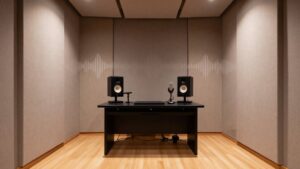
Treat first-reflection points before adding absorption elsewhere, because these single-bounce paths reach your listening position soon after the direct sound and can blur stereo imaging, tonal balance, and speech clarity. On side walls, use the mirror method: sit at the listening position while another person slides a mirror along each wall, then mark locations where you see either speaker. Those marks identify first-reflection paths.
Install appropriately thick, fabric-wrapped panels there; greater thickness usually extends useful absorption lower than thin foam. Treat ceiling or other confirmed single-bounce surfaces similarly. After installation, listen critically to familiar material and speech. You’ll hear whether imaging stabilizes, clarity improves, and further absorption is necessary.
Prioritize these locations before treating rear walls, corners, or broad unused surface areas at all.
Conclusion
To improve room acoustics, you should prioritize thickness, core material, and placement over surface appearance. Dense fiberglass or mineral-wool panels generally absorb more broadband energy than thin open-cell foam, especially at lower midrange frequencies. Use NRC data by band, not a single headline rating, to compare products. Mount panels securely, account for humidity, fire requirements, and damage exposure, then treat first-reflection points before adding coverage elsewhere. You’ll achieve tighter monitoring and more predictable reverberation control.