How to Choose Studio Headphones for Tracking, Mixing and Podcasting
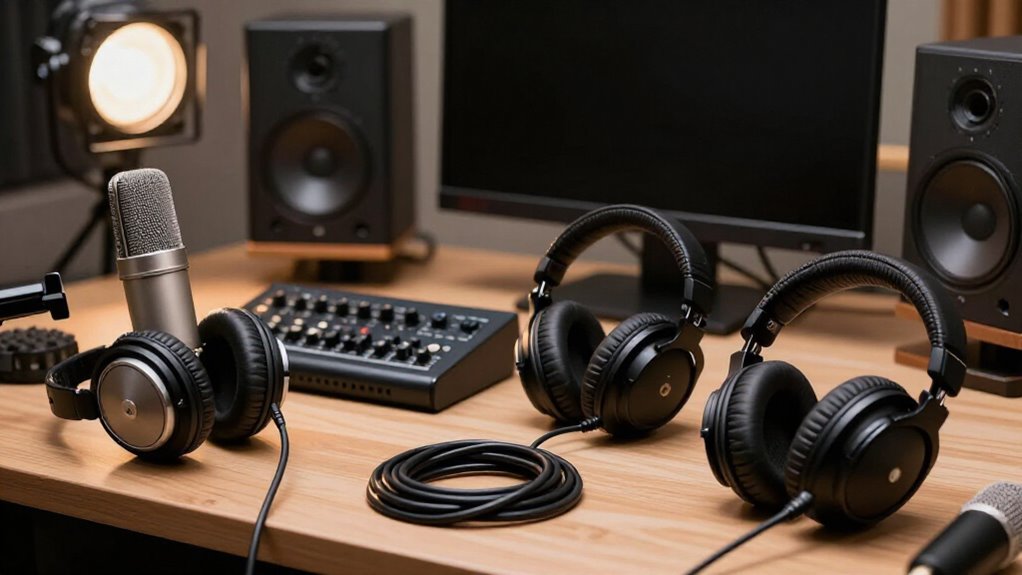
Choose closed-back headphones for tracking to limit click and backing-track bleed, and provide one cue output per simultaneous performer. Use neutral, open-back references for mixing when isolation isn’t required.
Match impedance and sensitivity to your interface’s voltage capability, not its volume knob. For podcasting, choose low-clamp, circumaural cups that stay comfortable while you speak.
Favor replaceable pads, detachable cables, balanced tuning, and a two-year warranty. Fit, seal, connector, and sensitivity checks below refine your choice.
Start With Closed-Back Tracking
Start with wired closed-back headphones for tracking, where isolation matters more than an open, spacious soundstage. Their sealed cups limit click-track and backing-track bleed into vocal or instrument microphones, helping you capture cleaner takes. Prioritize a secure, comfortable fit: adequate clamping stabilizes the headphones during performance, but undersized ear cups can create pressure on larger ears during long sessions.
Closed-back construction reduces leakage; it doesn’t eliminate it. Verify real-world isolation by briefly muting the control-room click and listening for residual pickup on the recorded track. Favor serviceable models with replaceable cables and earpads, since these parts receive the most wear in studio use. The Sennheiser HD 480 PRO suits tracking with passive isolation and a detachable coiled cable that connects to either ear cup.
Count Simultaneous Cue Mixes
Count every performer who must hear a cue mix simultaneously, then supply a headphone output and pair for each one. For a band session, inventory singers and instrumentalists present. Your system must support full headcount at once, not only the number of musicians overdubbing today.
Use several affordable closed-back pairs for tracking, since their isolation reduces click-track leakage into microphones. Verify results during setup: briefly mute the control-room click and listen for its pickup on each armed microphone. Closed backs don’t eliminate bleed completely. If you hear click contamination, send the click to one earpiece or hard-pan it to one side. Reserve a good open-back pair for mixing. You can also offer open-backs to performers when room sound and limited backing-track spill fit the session.
Match Impedance to Interface Output
Match headphone impedance to your interface’s available output voltage, not just its front-panel volume setting. Higher-impedance headphones generally need more voltage, so check your interface’s published impedance range and maximum output level before selecting them. Don’t assume impedance predicts loudness; sensitivity also determines achievable SPL.
| Model | Impedance |
|---|---|
| AKG K712 Pro | 62 ohms |
| Sennheiser HD 490 Pro | 130 ohms |
| Shure SRH1840 | 65 ohms |
The 62-ohm K712 and 130-ohm HD 490 Pro can demand different output levels. If your interface runs the 65-ohm SRH1840 quietly, add a good-quality headphone amplifier. Compare sensitivity alongside impedance, then verify that your expected monitoring level arrives without pushing the output to its limit. This prevents a dim, underpowered cue feed from misleading your tracking or mixing decisions in daily sessions.
Prioritize Replaceable Earpads
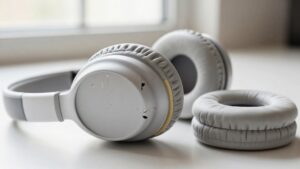
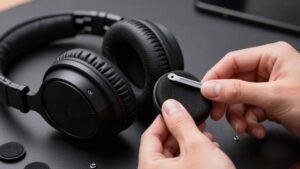
Choose headphones with replaceable earpads so you can renew worn contact surfaces instead of replacing the entire unit. You’ll maintain comfort and a reliable acoustic seal, especially important because glasses or poor-fitting pads can reduce bass response. Match pad material and cup size to your tracking or mixing sessions, and verify that compatible replacements remain readily available.
Extend Headphone Lifespan
Prioritize headphones with replaceable earpads to protect your long-term investment: pads compress, crack, and lose cushioning through regular tracking and mixing sessions. Treat earpads as consumable, serviceable components rather than permanent parts.
Before purchasing, verify that the manufacturer or third-party suppliers stock pads specifically for that exact model; mounting rings, attachment tabs, pad depth, and dimensions aren’t universal. This check prevents a wear item from shortening the working life of an otherwise functional headphone.
For frequent studio duty, assess replacement-cable availability and connector design. A detachable, sourced cable lets you remedy intermittent connections, damaged plugs, or conductor fatigue without replacing the entire unit. Build these service parts into your buying criteria, and you’ll reduce downtime, preserve a monitoring setup, and lower lifetime ownership cost.
Maintain Comfort And Seal
Comfort and acoustic seal directly affect both session endurance and monitoring accuracy, so assess earpad fit as carefully as driver performance. You need cushions that distribute pressure around, rather than onto, your ears. The AKG K712 Pro’s large, velour-feeling pads surround the ear and suit extended sessions. By contrast, the Sony MDR-7506’s firmer clamp and smaller cups can create pressure points for larger ears.
Prioritize models with replaceable earpads: compression, surface wear, and reduced resilience eventually undermine comfort and fit, while fresh pads restore a used pair’s serviceability. For closed-back tracking, test seal with your glasses and long hair. On models including the Sennheiser HD 480 PRO and FIIO FT1, broken contact can reduce bass. Test longer for heat, fatigue, or seal shifts.
Match Pads To Use
Match pad design to the session: soft memory-foam pads, such as those on the Shure SRH1540, reduce fatigue during long tracking or podcasting work, while velour pads on the Sennheiser HD 490 Pro and AKG K712 Pro suit extended mixing through their softer contact surface.
Prioritize replaceable pads: daily compression, sweat, and skin oils eventually change cushioning, fit, and acoustic sealing. For closed-back tracking, verify an even seal around your ears; glasses or long hair can leak on the FIIO FT1 and reduce bass.
Material isn’t sufficient: opening size, depth, and clamp interaction govern pressure distribution. Sony MDR-7506 small oval pads may press on larger ears, so wear them through a full session, not just a brief fit check. Choose pads with stable seals.
Check Replacement Availability
Pad choice only pays off long term if you can replace worn pads when their cushioning or seal changes. Before buying, verify that the manufacturer or established third parties still sell earpads, not merely generic alternatives. Frequent tracking and long podcast sessions compress foam, alter clamping contact, and reduce hygiene, so replacement availability directly extends useful service life.
Evaluate comfort alongside serviceability: the AKG K712 Pro’s large, cushioned velour-feeling cups suit extended wear, provided replacements remain obtainable. Pad condition also affects monitoring accuracy. On the FIIO FT1, an incomplete seal, including one disrupted by glasses, can noticeably reduce bass. Don’t infer pad support from a replaceable cable; cable and earpad serviceability are separate. Confirm part numbers, attachment method, cost, and supply before committing.
Podcasters Need Low-Clamp Designs
For long podcast sessions, choose low-clamp headphones that maintain a stable seal without creating pressure hotspots that distract you on air. Match the fit to your ears: full-size cups, low weight, and cushioned pads reduce fatigue, while models such as the 235 g AKG K712 Pro prioritize extended comfort. If you wear glasses, test them during fitting because the frames can alter the earpad seal and reduce bass on some models.
Prioritize Gentle Clamping Force
Gentle clamping force matters when you record or edit podcasts for hours, because sustained side pressure can cause fatigue even when a headphone’s sound quality is suitable for studio work.
Assess clamp independently from pad softness and weight. The Sony MDR-7506 remains stable during tracking, yet its firmer lateral pressure may not suit your head width or ear geometry. ATH-M50x pads provide cushioning, but padding doesn’t prove a low-clamp fit. By contrast, the lightweight AKG K712 Pro combines large, velour-feeling cushioned cups with a reputation for extended-session comfort.
Whenever possible, audition each model. Wear it enough to judge whether the headband distributes force evenly around your temples. Fit varies by skull shape and ear size, so choose the lowest effective clamp that stays secure.
Prevent On-Air Discomfort
Low clamp only helps if the entire fit prevents distraction while you’re speaking. Assess cup geometry alongside headband pressure: small oval ear cups, such as those on the Sony MDR-7506, can contact larger ears and create localized soreness even when clamp seems manageable. Favor low mass and compliant, spacious pads that distribute load without trapping your ears.
At 230 g, the MDR-7506 is light, but the 235 g AKG K712 Pro pairs similar weight with large, cushioned cups and a comfortable fit. The lightweight Sennheiser HD 490 Pro likewise uses velour cushions and generous ear-cup spacing. Test each candidate while wearing your glasses. Temple arms can interrupt the earpad seal, changing bass response, as users reported with the FIIO FT1, and introduce pressure points.
Match Fit to Sessions
Podcasters should prioritize low-clamp, circumaural headphones because continuous speech makes jaw, temple, and ear pressure more noticeable over time. For extended narration, evaluate clamping force alongside cup depth, pad compliance, weight distribution, and adjustment range.
The 235 g AKG K712 Pro suits long sessions with large, cushioned velour cups that surround rather than compress your ears. The ATH-M50x offers generous cushioning and a sturdy adjustable structure, giving beginners a practical starting point for longer recording blocks. By contrast, the Sony MDR-7506’s firm clamp improves security but can create localized pressure, particularly if its small oval cups don’t match your ear size. Reserve firmer designs, such as the DT 770 Pro X, for tracking, where plush pads and stable positioning can outweigh sustained-pressure concerns. Reassess fit after speaking.
Test Comfort With Glasses
If you wear glasses, test headphones through a full recording-length session rather than relying on a brief fit check. Even a model that initially feels comfortable can drive your glasses’ arms into the sides of your head beneath the pads, creating fatigue over an episode or interview. Glasses also interrupt the pad-to-head seal, so assess bass response and isolation while speaking and monitoring; the FIIO FT1 has shown noticeable bass loss with a compromised seal.
For podcasting, prioritize low-clamp designs. High clamping force stabilizes cups, but it can become painful during long takes, as noted with the Sony MDR-7506. Confirm that cups surround, rather than compress, your ears; its small oval cups may not suit larger ears. Adjust the headband, reseat the cups, and repeat comparisons, since positioning changes comfort, seal, and bass.
Verify Detachable Cable Connector
Inspect the cable connection at the ear cup before buying studio headphones, since a detachable lead can be replaced after wear or damage instead of sidelining the entire headset. Confirm which cup receives the plug and whether the design supports left- or right-side routing. The Sennheiser HD 490 Pro accepts its cable on either side and includes a 1.8 m lead.
Likewise, the HD 480 PRO uses a detachable coiled cable that plugs into either cup. Don’t treat detachable systems as universal: Audio-Technica’s ATH-M50x uses a proprietary connection, so aftermarket leads must match its specific locking interface. Check the supplied cable’s length, shape, connector geometry, and strain relief against your setup. Choose coiled leads for slack control; straight leads suit fixed desk positions well.
Check Two-Year Warranty Coverage
Before you buy, confirm that the manufacturer provides at least a two-year warranty covering defects in materials or workmanship. Verify the coverage start date, usually the purchase date, and retain your receipt, registration record, or other proof of purchase. Read exclusions line by line: earpads, cables, accidental damage, and commercial use may fall outside the policy.
Determine whether authorized warranty service operates in your country and whether you must pay outbound or return shipping for repairs or replacements. Also check whether the remedy is repair, replacement, or a prorated credit, and document any confirmation in writing for future service claims.
Avoid Consumer Bass Boosting
Because many consumer headphones elevate the low end for impact, they can cause you to understate bass in a mix that later sounds thin on neutral speakers or reference systems. Prioritize a balanced frequency response; extended-bass claims don’t establish accuracy. Evaluate the headphone as a monitoring tool:
- Choose models with smooth, un-hyped lows; the HD 490 Pro remains particularly flat from roughly 50 Hz to 1.5 kHz.
- Treat the MDR-7506’s limited sub-bass as a reason to verify bass-heavy work on another trusted reference.
- Check seal consistency: glasses or long hair can reduce FIIO FT1 bass by breaking earpad contact.
- Use familiar reference tracks to expose exaggerated kick and bass relationships before committing EQ.
That discipline keeps your low-end translation dependable.
Compare 1 kHz Sensitivity Ratings
After confirming a headphone’s tonal balance, compare its 1 kHz sensitivity only on a like-for-like basis: it indicates SPL from a stated input, not monitoring accuracy. Match both unit and test condition before estimating whether your interface or headphone amp can reach workable levels.
- Sennheiser HD 490 Pro: 96 dB SPL/mW at 1 kHz.
- AKG K712 Pro: 105 dB SPL/V at 1 kHz; don’t rank it against the HD 490 Pro without conversion and impedance data.
- Audio-Technica ATH-M50x: 99 dB, but its supplied specification omits the 1 kHz reference and measurement unit.
- HEDD Heddphone Two: impedance and frequency-response specifications can’t establish loudness.
A 1 kHz result samples one frequency; it can’t predict tonal accuracy or full-spectrum output levels in practice during real monitoring sessions.
Conclusion
Choose closed-back models for tracking, then calculate how many cue mixes you’ll run before buying. Match headphone impedance and 1 kHz sensitivity to your interface’s available voltage, and avoid consumer bass boosts when you mix. For long podcast sessions, select low-clamp designs with replaceable earpads and a confirmed detachable-cable connector. Finally, verify that the manufacturer’s two-year warranty covers drivers, cables, and pads. You’ll get reliable monitoring, practical serviceability, and fewer workflow compromises under demanding schedules.
For practical guidance on this related topic, see our guide to in-ear monitors headphones isolation comfort and.