Can Acoustic Panels Reduce Noise From Neighbors? What They Can and Can’t Block
Acoustic panels can make your room sound calmer, but they can’t meaningfully block neighbour noise through shared walls, ceilings, or floors. Their NRC rating describes absorption of in-room reflections, helping reduce echo and improve speech clarity; it doesn’t measure sound isolation.
To reduce transmitted voices, bass, or impact noise, you need airtight gaps, added mass, and often decoupled construction, assessed by STC. Panels remain useful after isolation work, as the distinctions below explain in detail.
Panels Absorb Echoes, Not Neighbors
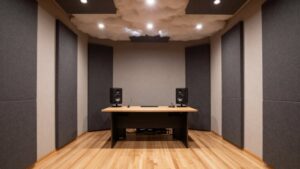
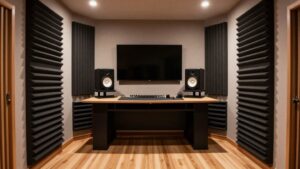
Acoustic panels improve how sound behaves within your room, but they don’t meaningfully block noise from neighbours. They absorb reflected sound inside the space, which shortens echo and reverberation. Porous foam or fabric lets air motion enter its structure; friction converts part of that acoustic energy to heat.
This can make your speech, music, and television clearer by reducing competing reflections. However, sound transmitted through a shared wall, ceiling, or floor remains largely unchanged. In some rooms, neighbour noise may even seem more noticeable once reflections fall away. To limit building-borne transmission, you need construction measures that add mass, isolate surfaces, and seal gaps. Panels still complement those measures by improving the listening environment rather than reducing the sound that enters your room.
NRC Ratings vs. STC Ratings
NRC and STC measure different aspects of sound control, so you can’t compare their numbers directly. NRC, or Noise Reduction Coefficient, indicates how effectively a material absorbs sound within your room. A high NRC panel can reduce reverberation and improve speech clarity, but it doesn’t indicate resistance to sound entering through a shared wall.
STC, or Sound Transmission Class, evaluates an building assembly’s ability to reduce airborne sound transmission. Higher STC values indicate stronger isolation. If neighbour noise is your concern, assess the STC of the wall, ceiling, door, or separating assembly. Include details that create weak points, such as gaps around penetrations or edges. An acoustic panel’s NRC rating tells you about absorption in your space; it doesn’t quantify the assembly’s transmission loss.
Bass Through Party Walls
Bass through a party wall behaves differently from ordinary room echo: low-frequency energy excites the wall and connected structure, allowing vibration to pass into your space. Because low-frequency vibration travels through rigid building elements, porous absorbers used for room reflections won’t supply the mass or isolation required to stop it. You may hear bass even when speech seems limited, because floors, junctions, and service penetrations can carry energy around the shared wall.
Effective control usually requires a system that adds dense layers, decouples new construction with resilient channels or isolation clips, and seals gaps at sockets, pipes, and skirting boards. For severe transmission, an acoustic consultant can identify dominant vibration paths and determine whether an isolated wall system is justified; performance depends on construction.
Wall, Ceiling, and Freestanding Panels
Place wall panels at reflection points to reduce echo and improve clarity in your room, but don’t expect them to block neighbour noise through a shared wall. Ceiling and freestanding panels likewise control reverberation, not impact noise from above or transmission through building gaps. To reduce sound transfer, you’ll need sealed gaps, added mass, and resilient isolation; use panels afterward to refine room acoustics.
Wall Panel Placement
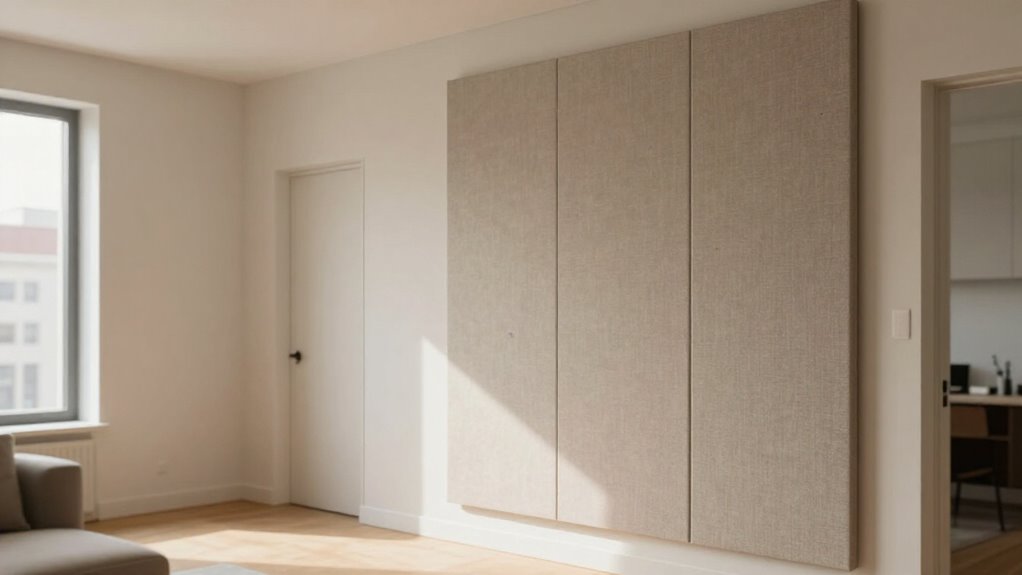
Where you position acoustic panels determines how effectively they control reflections inside your room, not how much neighbour noise the wall transmits. Mount panels on reflective wall areas, particularly the shared wall, to absorb mid- and high-frequency energy that would otherwise bounce back into the room. This lowers reverberation and improves speech, television, and music clarity at the listening position.
It doesn’t materially increase the wall’s sound insulation, because airborne transmission depends on mass, airtightness, structural isolation, and leakage paths. Use panels alongside measures such as sealing perimeter gaps, sockets, pipe penetrations, and skirting-board voids, while adding mass or decoupling where feasible. A less reverberant room can also make incoming neighbour noise seem more distinct, since less reflected sound masks it during quieter periods indoors.
Ceiling Noise Considerations
Wall, ceiling, and freestanding acoustic panels absorb reflected sound within your room, but they don’t provide meaningful protection from neighbour noise transmitted through shared walls, ceilings, or structural connections. For upstairs footsteps or other impact noise, surface-mounted ceiling absorbers won’t interrupt the vibration travelling through the floor-ceiling assembly. Effective control generally requires a decoupled ceiling: resilient channels or isolation clips separate new lining from structural framing. Add dense board layers, use appropriate damping where specified, and seal perimeter gaps and penetrations to reduce airborne leakage.
Because flanking paths through joists, walls, services, and connections can dominate performance, you should identify the transmission route before construction. Ceiling soundproofing is substantial work; an acoustic consultant can assess the assembly and recommend measures matched to noise source.
Freestanding Panel Applications
Freestanding panels give you flexible control of reflections around a speaker, TV, desk, or listening area, while wall- and ceiling-mounted panels treat broader in-room echo. You can position movable absorbers near a talker or playback source to reduce early reflections, improve speech intelligibility, and clarify stereo imaging. Wall panels similarly reduce reflected energy within the room; ceiling panels soften overhead reflections.
None of these absorbers, however, provides the mass, airtightness, or structural decoupling needed to stop neighbour noise through shared walls, floors, or ceilings. For transmission problems, combine appropriate treatment with added mass, resilient isolation, and sealed gaps. An acoustic assessment can identify dominant paths and determine whether your room needs strategically placed wall, ceiling, or freestanding treatment, or a soundproofing upgrade where needed.
Gaps Around Electrical Outlets
Gaps around electrical outlets can leak neighbour noise through a shared wall, while acoustic panels only absorb reflections within your room. You can seal accessible perimeter gaps with an appropriate acoustic sealant, but don’t cover electrical components or obstruct the box. If noise persists, have an acoustic consultant assess the outlet and wall for sealing, added mass, or isolation measures.
Why Outlet Gaps Leak Sound
Although a shared wall may contain dense materials, gaps around electrical outlets can create direct air paths that let neighbour noise bypass those layers. Airborne sound follows these discontinuities because even small openings reduce the wall assembly’s effective airtightness. You may hear speech or television more clearly near an outlet when the box, its perimeter, or wall finish leaves an opening.
The box can interrupt cavity insulation, creating a weaker section than the surrounding wall. Acoustic panels in your room absorb reflected sound; they don’t block transmission through outlet openings. The severity depends on opening size, box placement, cavity construction, and whether outlets sit back-to-back on opposite sides. Closing accessible perimeter gaps can reduce leakage, but it won’t eliminate structure-borne or broad wall transmission.
Sealing Electrical Box Gaps
Before sealing around an outlet, switch off the circuit at the breaker and verify that the receptacle is de-energized. Remove the cover plate, then inspect the perimeter where the electrical box meets the finished wall. Apply an appropriate acoustic sealant only to this accessible joint, creating a continuous bead that closes air gaps without entering the box or contacting conductors.
If the opening exceeds what sealant can bridge, use a compatible fire-rated material when local code requires it. Don’t obstruct the receptacle, cover mounting points, wiring, or box access. This treatment reduces one potential flanking path through a shared wall by limiting airborne sound leakage. However, its effect is modest: it won’t provide mass, damping, or structural isolation needed to control noise transmitted through the wall assembly.
Safe Soundproofing Around Outlets
Small openings around electrical outlets can leak airborne neighbour noise through a shared wall. You can reduce this flanking path by sealing the box’s outer perimeter or fitting a listed outlet gasket beneath the cover plate.
Before you begin, switch off the circuit at the breaker and verify that the outlet is de-energized. Never place acoustical sealant, foam, or any other material inside the electrical box. Use only products approved for electrical applications, and follow their installation instructions.
Don’t obstruct ventilation openings, conceal damaged wiring, or use ordinary unrated foam. Call a qualified electrician if you’re uncertain. Outlet sealing limits air-path leakage; it won’t block structure-borne or wall-transmitted sound, which may need added mass or isolation measures elsewhere in the assembly for meaningful results.
Home Office Call Clarity
Acoustic panels can make your home office calls clearer by absorbing reflections that would otherwise prolong speech and muddy your voice. Position them on reflective walls near your desk, especially at first-reflection points, to reduce early echoes reaching your microphone. This lowers reverberant energy relative to direct speech, so callers can distinguish consonants and follow your words more reliably.
Panels don’t stop neighbours’ voices transmitted through shared walls, ceilings, or floors. If intrusion still disrupts calls, seal gaps around sockets, pipes, and skirting boards where practical, then assess structural soundproofing. Combining absorption for room acoustics with measures that limit transmission gives you clearer outgoing speech and less background noise. Treat the room first, but address transmission paths when external noise remains operationally significant.
Lease Restrictions on Wall Modifications
Lease terms can limit how you install panels, even when you only want to improve call clarity rather than alter the building. If your lease prohibits drilling or other wall modifications, obtain your landlord’s written permission before mounting acoustic panels.
These products absorb reflected sound within your room; they don’t function as soundproofing barriers and generally won’t stop noise crossing a shared wall. Review restrictions on adhesive strips, ceiling-mounted panels, paint, and finishes, because each can damage surfaces.
For a removable setup, use freestanding acoustic screens or attach panels with a landlord-approved, non-damaging method. If neighbor noise calls for dense added layers, isolation systems, or sealed gaps, consult your landlord before arranging the work. Structural changes require approval and may directly affect building assemblies.
Egg Cartons Don’t Soundproof Walls
Egg cartons won’t block neighbour noise because their thin, lightweight material adds negligible mass to a shared wall. Their moulded shape may scatter a small amount of reflected sound, but scattering neither absorbs sound reliably nor stops transmission through the structure. Cartons aren’t engineered or tested as acoustic treatments, so you can’t expect predictable echo control or isolation.
To reduce transmission, you need a system that addresses the wall’s weak points:
- Add dense layers to increase surface mass.
- Seal perimeter gaps and penetrations.
- Use decoupled framing or resilient isolation.
- Treat panels as echo control, not barriers.
Even purpose-made porous panels primarily absorb airborne reflections within your room; they don’t create the mass, airtightness, or mechanical separation needed to impede neighbour sound effectively through walls.
Check Decibel Levels First
Before you buy any treatment, measure the noise inside the room where you hear it. Use a decibel-meter app or meter, and log the time, duration, and character: steady hum, voices, or impacts.
| Reading | What to note |
|---|---|
| Baseline | Quiet-period level |
| Event | Level during neighbor noise |
| Repeats | Same location, several samples |
| Type | Airborne speech/TV or impact footsteps |
Take repeated readings from the same position because sound fluctuates; one result may not represent typical exposure. Compare event readings with the quiet baseline to identify clearly when the disturbance peaks. These values document the issue, but they don’t reveal by themselves how much sound passes through a wall. Classify the dominant noise: airborne speech or television usually requires different next steps than impact noise from footsteps.
Conclusion
Acoustic panels can improve your room’s sound by reducing reflections, flutter echo, and call fatigue, but they won’t stop most neighbor noise crossing walls, ceilings, floors, outlets, or structural paths. Use NRC data to judge absorption and STC/IIC strategies to judge isolation. For bass, prioritize mass, sealing, decoupling, and controlled ventilation. Measure sound levels first, identify transmission routes, and check lease limits before modifying surfaces. Avoid egg cartons; choose tested materials and realistic expectations.