In-Ear Monitors vs Headphones: Isolation, Comfort and Accuracy for Musicians
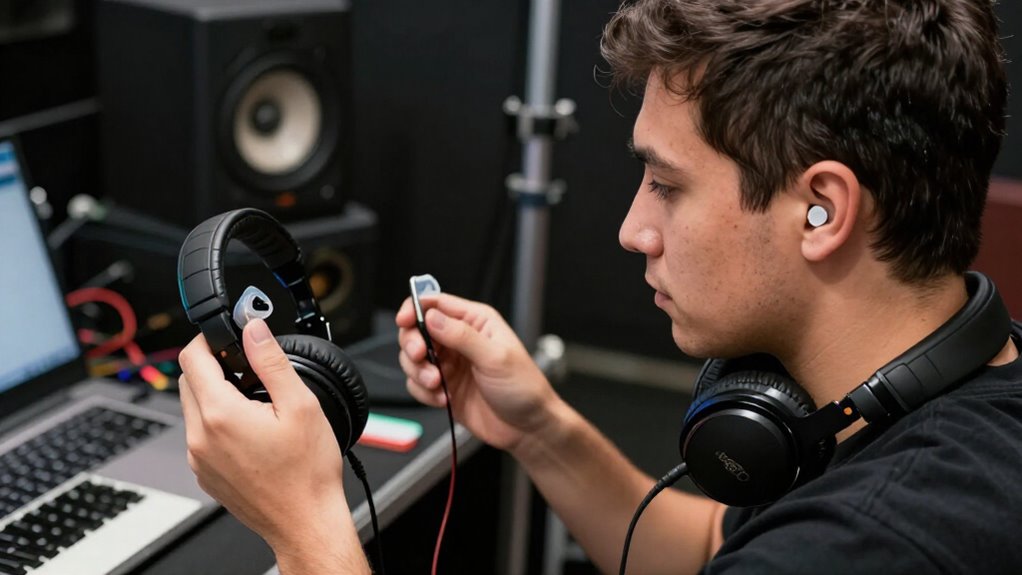
For musicians, you’ll get markedly better passive isolation from properly sealed IEMs than from closed- or open-back headphones, letting you hear clicks, backing vocals, and low-level cues at safer levels. Their seal stabilizes bass and improves signal-to-noise ratio, but inconsistent fit, occlusion, and wireless battery dependence can affect comfort and reliability.
Custom molds improve repeatability but require time and adjustment.
Next, compare driver choices, fit methods, and use-case tradeoffs for drummers, commuters, and studio tracking needs.
IEM Isolation vs Headphones
IEMs provide substantially stronger passive isolation than headphones because their tips seal the ear canal and form a physical barrier against external sound. You reduce stage distractions, so click tracks, backing vocals, and subtle synth lines remain easier to resolve at practical monitoring levels. Typical closed-back headphones attenuate less ambient sound; open-back models provide virtually no meaningful isolation. A Sennheiser IE 100 Pro can reach approximately 26 dB attenuation, illustrating the advantage.
Bone-conduction devices create no isolation, so your mix competes directly with venue ambience. That controlled acoustic environment lets you distinguish low-level musical cues without raising volume excessively, helping you make faster, more reliable performance decisions when crowd noise and stage spill increase.
| Device | Isolation | Monitoring result |
|---|---|---|
| IEMs | Strong | Clearer details |
| Open-back | Minimal | Ambient dominates |
Drivers, Seals, and Signal Paths
At the eardrum, an IEM’s driver and airtight ear-canal seal work as a single acoustic system: the driver reproduces the monitoring signal millimeters from the tympanic membrane, while correctly sized tips limit external masking and stabilize bass, midrange, and treble perception.
Balanced-armature arrays emphasize midrange and high-frequency resolution; dynamic drivers supply low-frequency excursion and impact. Planar magnetic designs prioritize low-distortion transients. Yet seal depth governs delivered response: insert too deeply and you may create bass overload; insert inconsistently and clarity falls.
Choose a wired path, since SBC or AAC compression removes information. aptX HD and LDAC reduce, but don’t erase, wireless loss. Interchangeable filters, such as the SE846 Pro’s balanced, warm, and bright inserts, let you alter voicing without changing fit.
Stage Mix Clarity at Volume
When stage volume rises, a properly sealed IEM isolates the monitoring feed from amp wash, cymbals, and crowd noise, so you can distinguish click tracks, backing vocals, and subtle arrangement cues without forcing the mix louder. That seal suppresses ambient bleed before it reaches your eardrum, improving the signal-to-noise ratio rather than merely increasing level.
Since IEM drivers operate millimeters from your eardrum, you can identify low-level synth parts and timing information at lower monitor settings. Closed-back headphones reduce some spill and can improve focus, but their passive isolation generally remains below that of sealed IEMs under stage conditions.
Consequently, you retain intelligibility as drums and amplifiers get louder while avoiding unnecessary gain that accelerates fatigue. Some provide 37 dB attenuation, protecting your hearing.
Custom-Mold Fitting Time
Custom-mold IEMs demand more upfront time because an audiologist must take ear-canal impressions and the manufacturer must build shells around your anatomy. Unlike swapping universal tips, this process adds appointments, production lead time, and an adjustment phase. Its value is mechanical consistency: a stable shell position minimizes fit variance, so bass response, stereo imaging, and isolation remain repeatable across rehearsals and gigs.
- Your impressions create shells that maintain an airtight seal, attenuating outside sound and clarifying click tracks, backing vocals, and low-level synth detail.
- You may still refine insertion depth and orientation initially; small changes affect pressure, comfort, and low-frequency accuracy.
- Once adjusted, the custom interface reduces movement during long sessions, limiting seal breaks that compromise monitoring precision.
It trades delay for predictable long-term performance.
Wireless Belt-Pack Compatibility
IEMs pair more effectively with wireless belt-pack systems because their sealed fit supplies the passive isolation needed to hear the pack’s line-level, codec-processed monitor feed over crowd and stage noise.
This isolation lets you distinguish clicks, backing tracks, and vocal cues despite wireless latency and compression. Choose attenuation deliberately: Shure SE846 Pro reaches roughly 37 dB, while Sennheiser IE 100 Pro provides about 26 dB. Higher passive attenuation reduces ambient masking, limiting excessive belt-pack levels.
You should also evaluate fit security during movement. An over-ear cable route, such as the SE846 Pro’s front-facing design, keeps the earpieces taut when you turn, jump, or handle instruments. By contrast, headphones, particularly open-back designs, admit and leak more stage sound, obscuring monitor detail and weakening belt-pack usability.
Replaceable Cables and Resale Value
Replaceable cables give in-ear monitors a practical service advantage over fixed-cable headphones: if a lead fails, you can replace it rather than discard the earphones.
- Shure’s detachable systems, including the SE215 Pro, let you isolate a common wear component from the transducers. Sennheiser’s IE 100 Pro similarly uses detachable coaxial connectors, simplifying field repair.
- By retaining serviceable earpieces, you extend usable life and lower ownership cost; replaceable tips and cables also make maintenance more predictable on the road.
- You’ll protect resale value when buyers can obtain supported replacement parts rather than accept a fixed-cable failure as terminal. Secure cable routing matters too: the SE846 Pro’s front-facing layout forms a snug loop, reducing motion-induced strain and preserving connector integrity over repeated performances and transport cycles.
Occlusion Effect and Vocal Perception
Because a sealed in-ear monitor traps sound in the ear canal, it can produce an occlusion effect that makes your own voice seem louder, bassier, and less natural than it does with open headphones.
With IEM drivers positioned millimeters from your eardrums, an airtight seal changes vocal timbre and increases perceived low-frequency energy. You may also hear click tracks and backing vocals as more prominent, since the sealed canal reinforces internally transmitted bass. Bone-conduction systems leave the canal open, so your voice retains a more natural blend of direct and room sound.
If your vocal sound becomes boomy, adjust insertion depth or ear-tip fit. Trying another tip size or filter can rebalance the seal and improve vocal realism without sacrificing necessary isolation onstage reliably.
Battery Dependence and Failure Points
Wireless IEMs require you to manage battery charge and case availability, since a depleted cell can end monitoring mid-gig. You must also account for battery aging, charging-cycle wear, and cable or connector faults that can reduce reliability.
Wired IEMs and headphones eliminate power-related interruptions, though you still need to manage fit and physical cable stress.
Power and Charging Reliance
Power dependence creates a practical reliability gap between wired IEMs and wireless listening gear. Wired IEMs require no charge, so you eliminate runtime limits and wireless dropouts during critical monitoring. Wireless models can deliver many hours, but a rehearsal, gig, or tour can exceed one charge cycle. You must manage energy as part of your signal path:
- Check remaining charge before soundcheck and recharge the case during breaks.
- Carry a fully charged backup case or charger; don’t treat advertised runtime as guaranteed.
- Select transmission settings deliberately. SBC or AAC may preserve battery differently than aptX HD or LDAC, and low-power modes can alter perceived detail and accuracy.
If your priority is zero-stress continuity, wired monitoring removes the power-management variable.
Plan charging before every set.
Common Failure Points
Reliability failures in in-ear monitoring usually stem from finite battery capacity, mechanically stressed cables and connectors, poor ear-tip seals, or neglected acoustic components rather than from the drivers alone. Wireless systems add a power-related risk: as charge falls, audio may degrade or drop out.
For rehearsals and live sets, you should favor wired IEMs or transmitter packs with runtime. Stage movement concentrates stress at cable exits and connectors; detachable cables let you replace the sacrificial part. Don’t misdiagnose a bad seal as an electronic fault: an unsealed tip reduces passive attenuation and changes bass balance and accuracy.
Clean vents, replace worn tips and filters, and install tuning inserts correctly. Choose touring-grade construction when you need durability; choose inexpensive units only when planned replacement is acceptable.
Drummers, Commuters, and Studio Tracking
As a drummer, you can use an IEM’s ear-canal seal to attenuate stage volume and hear your mix without depending on wedges.
During a commute, you get stronger passive isolation and greater portability than earbuds or most closed-back headphones provide. For studio tracking, IEMs place drivers near your eardrums, so you can resolve click tracks, backing vocals, and other low-level cues more precisely.
Drumming Isolation And Impact
For drummers, IEMs provide substantially stronger passive isolation than open-back or most closed-back headphones, so you can hear click tracks, backing vocals, and transient detail without competing against kit bleed. A proper seal physically attenuates external sound, producing a cleaner, stable monitoring reference than headphones can deliver.
- It preserves kick and snare articulation because cymbal wash no longer masks low-frequency attack.
- Driver proximity, millimeters from your eardrum, sharpens transient definition without requiring excessive level.
- With a well-fitted wireless system, you can keep cues repeatable across rehearsals and studio takes.
That consistency lets you judge timing and dynamics against a controlled mix, not changing acoustic bleed. Some models offer up to 37 dB attenuation, supporting safer monitoring levels during rehearsal sessions.
Commuting Noise And Portability
IEMs handle commuting noise more effectively than most headphones because their ear tips seal the canal and reduce street, rail, and cabin sound before it reaches your mix. That barrier lets you hear click tracks, backing vocals, and subtle cue lines without raising level excessively, which matters for you as a commuting drummer. Open-back headphones admit and leak environmental sound, so they suit quiet rooms rather than trains or sidewalks.
IEMs also occupy less bag space, whereas over-ear designs add bulk and can create heat or pressure points on rides. Models such as Shure’s SE846 Pro provide up to 37 dB attenuation through isolation and filtering. Wireless IEMs are convenient, but SBC/AAC compression can discard detail; use wired IEMs when you need preserved signal.
Studio Tracking Accuracy
Isolation determines tracking accuracy: sealed IEMs block much of the kit, room, or commute noise before it reaches your ears, so click tracks, backing vocals, and low-level synth cues remain intelligible at controlled levels. During tracking, the sealed in-ear bubble puts drivers millimeters from your eardrums, sharpening imaging and low-level timing detail. It stabilizes monitoring across takes despite changing room sound.
- For drums, attenuation up to roughly 37 dB, as on Shure’s SE846 Pro, keeps your click distinct and timing repeatable.
- For commutes or loud rooms, sealed shells reduce outside sound; bone-conduction and non-sealing designs don’t.
- For critical overdubs, choose wired monitoring: wireless SBC/AAC codecs can mask subtle cues, whereas aptX HD or LDAC reduces compression artifacts but doesn’t eliminate them at all.
Prioritize Hearing Protection
Because a proper in-ear seal attenuates external sound by roughly 26 to 37 dB, IEMs let you hear a clear mix without raising monitoring volume to compete with stage SPL. This passive isolation is valuable in rock, metal, and pop, where stage levels can mask click tracks, backing vocals, and timing cues. Select tips that fully seal your canal at the insertion depth; a poor fit reduces attenuation and detail, encouraging unsafe gain increases.
Models vary: the Sennheiser IE 100 Pro provides about 26 dB, while the Shure SE846 Pro reaches up to 37 dB. By contrast, bone-conduction systems leave the canal open, offer no hearing protection, and expose you to full ambient SPL. Verify seal quality before performing, then set the lowest level that preserves cue audibility.
Conclusion
You’ll choose IEMs when you need maximum passive isolation, lower stage levels, wireless integration, and repeatable mix detail. A seal and drivers matter more than enclosure size, but custom molds require lead time and can increase occlusion.
Choose headphones when you need faster setup, less internal vocal emphasis, or easier shared tracking. In either format, you must manage batteries, fit, gain structure, and monitoring level. Protect your hearing first; accuracy depends on safe, sustainable SPL.