Cloudlifter vs FetHead: Which Inline Mic Booster Gives Cleaner Gain?
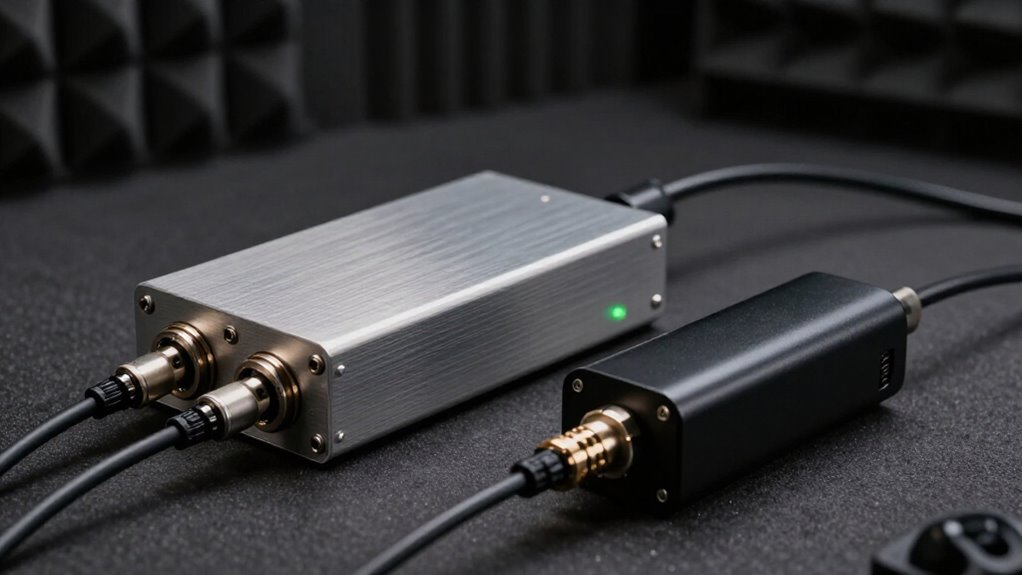
If you need the highest rated clean boost, choose the Triton FetHead: its Class-A JFET stage provides about 27 dB, versus the Cloudlifter CL-1’s 25 dB.
That 2 dB margin helps low-output SM7B, RE20, or passive ribbon mics approach an interface’s quiet-gain limit.
Neither booster alone determines system noise.
FetHead mounts at the mic with one XLR run; CL-1 uses two cables for fixed routing.
The details below clarify placement, phantom power, and noise tradeoffs in your setup.
27dB vs. 25dB Gain
The FetHead supplies 27 dB of clean inline gain, versus 25 dB from the Cloudlifter, a 2 dB advantage that gives you slightly more output before relying on your interface preamp. This represents roughly 10% more rated boost. You’ll notice it most with low-output dynamic or ribbon microphones when your interface approaches its quiet-gain limit.
| Unit | Gain | Difference |
|---|---|---|
| FetHead | 27 dB | Reference |
| Cloudlifter | 25 dB | -2 dB |
| Margin | 2 dB | FetHead higher |
Both units target transparent level increase, so neither rating establishes noise performance. The practical question is headroom before your downstream preamp adds gain. If you’re near the threshold where added interface gain introduces audible hiss, FetHead’s extra 2 dB can help. Otherwise, the measured gap remains modest, and you shouldn’t expect a level change.
Phantom-Powered FET Signal Boosting
Powered by 48 V phantom, both the Cloudlifter CL-1 and Triton FetHead use Class-A JFET circuitry to raise a passive dynamic or ribbon mic’s low-level output before it reaches your interface preamp. The CL-1 supplies up to 25 dB of gain; the FetHead supplies approximately 27 dB. You engage phantom power at the interface, but the booster consumes it to operate its amplifier and passes an elevated microphone signal downstream. This arrangement lets you use less gain at an underpowered interface preamp.
With passive ribbon microphones, placing either booster inline also prevents phantom voltage from reaching the ribbon, a useful safeguard for older designs. Use these devices only with passive dynamic or ribbon microphones. Condenser and active microphones require phantom power themselves, so this signal path isn’t appropriate.
Self-Noise in Quiet Recordings
In quiet recordings, both the Cloudlifter CL-1 and Triton FetHead add roughly 25 to 27 dB of clean gain ahead of the interface preamp, which can lower the audibility of preamp hiss when using low-output passive dynamic or ribbon microphones. Neither unit eliminates noise: it shifts gain away from the interface, so the system noise floor depends on the microphone, cable, booster, preamp, and recording level.
Their Class-A JFET stages are designed for low noise, but you’ll hear residual self-noise when high upstream gain makes the floor dominant. The Cloudlifter’s noise character is described as less hiss- or crackle-like, while FetHead aims for clear, frequency-neutral gain. Differences become relevant with quiet sources, long cables, and passive low-output microphones; compare recorded noise floors at matched output levels.
XLR Setup and Placement Time
After matching noise floors, compare the physical XLR chain: the Cloudlifter CL-1 requires two XLR cables, microphone to CL-1, then CL-1 to the interface or mixer, while the FetHead plugs directly onto the microphone and normally uses one XLR run to the preamp. That difference affects setup time and placement options. You position the CL-1 as a separate inline box, secure both connectors, and verify its 48 V supply from the preamp.
With FetHead, you attach the booster at the mic, connect the output cable, and supply 24 to 48 V. The FetHead’s arrangement reduces cable count from two to one and eliminates one connection pair. For long runs, either unit raises level before interface, reducing preamp gain. Confirm 48 V for CL-1 and 24 to 48 V for FetHead.
SM7B, RE20, and Ribbon Mics
For low-output microphones such as the Shure SM7B and Electro-Voice RE20, either booster supplies the clean level increase that keeps your interface preamp out of its highest-gain, noise-prone range: the Cloudlifter CL-1 provides up to 25 dB from 48 V phantom power, while the Triton FetHead provides 27 dB from 24 to 48 V. That gain margin lets you record speech without running a preamp flat out.
- Choose either unit when your interface becomes noisy near maximum gain.
- Use the FetHead’s direct-to-mic format if one XLR link simplifies your setup.
- Plan two XLR connections for the CL-1: microphone to booster, then interface.
- With passive ribbons, both units support passive ribbon/dynamic use while isolating phantom power from the microphone; FetHead’s 2 dB advantage can raise usable output.
$149 CL-1 Vs $99 Fethead
At typical street prices, the $99 Triton FetHead undercuts the $149 Cloudlifter CL-1 by about $50 while supplying 27 dB rather than 25 dB of phantom-powered gain. If you compare stated amplification per dollar, FetHead delivers 0.273 dB per dollar, versus 0.168 dB per dollar for the CL-1.
Its extra 2 dB equals an 8% increase relative to 25 dB, while its price is approximately 34% lower. Both units target low-output dynamic and ribbon microphones and position their gain as low noise, so published gain and cost don’t alone establish a universal noise-floor winner. However, FetHead measures out as the stronger value proposition on specified gain: you pay less and receive more available boost. It attaches directly to your microphone through one XLR cable.
Phantom Power Won’t Reach Mic
Both the Cloudlifter CL-1 and Triton FetHead draw phantom power from your interface to run their internal gain stages, but they don’t pass that voltage through to the microphone. Enable 48V for the CL-1; it uses that supply while adding up to 25 dB. The FetHead operates from 24 to 48V and provides up to 27 dB.
- Passive dynamic microphones receive amplified signal, not phantom voltage.
- Older passive ribbon microphones benefit because you isolate their elements from interface phantom power.
- Condenser microphones need phantom at the capsule electronics, so neither booster supports them as an inline stage.
- Verify your interface supplies stable phantom power before recording; otherwise the booster can’t operate or deliver its specified gain.
Use these activators only with passive, properly balanced XLR microphones.
Steel Box vs. Barrel
You get a compact high-quality steel FetHead chassis that mounts at the microphone, while the larger all-metal Cloudlifter barrel can sit anywhere in an XLR signal path. FetHead needs one attached connection point and reduces cable management; Cloudlifter typically uses two XLR cables.
Both housings support portable use, but you should choose by available mounting space and cable-routing requirements.
Chassis Design And Durability
FetHead uses a compact, high-quality steel barrel that mounts directly at the microphone connection, keeping its footprint low and its weight near 0.25 kg (just over 0.5 lb). Its steel shell prioritizes minimal mass and portability, while Cloudlifter uses a larger, rugged all-metal box designed for repeated professional use.
You can assess their durability priorities through enclosure geometry, material, and intended handling conditions:
- Choose FetHead when you need the smaller 0.25 kg chassis.
- Choose Cloudlifter when you prioritize a larger, sturdier metal enclosure.
- Expect both housings to support durable inline amplification.
- Compare physical size and chassis emphasis, not gain performance, here.
Neither construction claim supplies a quantified impact rating, so your decision rests on size, material, and stated durability focus during normal field use.
Mounting And Cable Management
Mounting layout changes how each booster affects cable routing: FetHead’s approximately 0.25 kg steel barrel attaches directly to the microphone and typically uses one XLR run, while the Cloudlifter CL-1 sits as a separate metal box between mic and interface and requires two XLR connections. With FetHead, you route one cable directly to your interface, eliminating a midpoint device and mating pair. This reduces visible slack, simplifies stand placement, and limits management in compact setups. The 0.25 kg barrel adds mic-end weight, so secure the XLR and avoid stressing a boom.
With CL-1, you support the box separately and manage mic-to-booster and booster-to-interface cables. That layout adds one connection point but keeps weight off the mic. Both need 48 V phantom power to operate.
Travel Kits: FetHead Wins
For travel kits, you can pack the ~0.25 kg FetHead in minimal space while adding up to 27 dB of clean JFET Class-A gain. Its direct-to-mic XLR connection reduces cable clutter versus a separate inline box and extra lead.
With 48 V phantom power available, you can set up a PodMic or SM58 quickly in backpacks, road cases, or small carts.
Pocket-Friendly Form Factor
Travel-kit efficiency favors the FetHead: its compact, direct-to-mic inline design can plug onto the microphone and delivers 27 dB of clean gain without adding a separate box to your signal chain. That architecture lets you pack a booster for dynamic or ribbon microphones in a smaller protected compartment. Its Class-A JFET stage operates from 24 to 48V phantom power, which your compatible portable interface can supply. At about 0.25 kg, or just over half a pound, the steel enclosure balances carry durability against mass.
By comparison, the larger Cloudlifter CL-1 occupies more bag volume. These specifications make it the more pocket-friendly option when your kit must meet strict size and weight limits.
- Gain: 27 dB.
- Phantom power: 24 to 48 V.
- Weight: approximately 0.25 kg only.
- Steel construction: high-quality, durable.
Reduced Cable Clutter
Cable management favors the FetHead in a mobile rig: its compact, mic-mounted inline design supplies +27 dB of clean gain with essentially one XLR connection. You attach the booster at the microphone end, so your signal path uses the mic, FetHead, and a single run to the interface. With an SM58 or PodMic, that layout reduces loose cable length, exposed connector pairs, and separate hardware compared with a Cloudlifter.
A Cloudlifter normally sits between the mic and interface, requiring two XLR cables: one from mic to booster and another from booster to interface. Both units require 48 V phantom power, so power requirements don’t change the comparison. However, the FetHead’s direct-inline package minimizes physical cable inventory. For kits, fewer XLR leads reduce clutter.
Fast Mobile Setup
That smaller cable footprint also speeds mobile setup: the FetHead plugs directly into a PodMic, SM58, or similar low-output mic, leaving one XLR run to the interface. You carry 0.25 kg steel FetHead rather than a bulkier Cloudlifter and eliminate mic-to-booster XLR connection. For travel recording, its Class-A JFET stage supplies up to 27 dB of controllable clean gain, 2 dB above Cloudlifter’s 25 dB, without frequency-response skew.
- Connect FetHead directly to your dynamic or ribbon microphone.
- Run one XLR cable from FetHead to your interface.
- Enable 48 V phantom power; both boosters require it.
- Set preamp gain lower, then verify target recording level.
This layout reduces cable count and connection steps, which improves repeatability when you’re moving between locations.
CL-1 for Fixed Studios
For a fixed studio built around passive dynamic or ribbon microphones, the Cloudlifter CL-1 supplies up to 25 dB of clean Class-A JFET gain from your interface’s 48 V phantom power. Place it between your microphone and interface or mixer, where its gain raises the signal presented to the preamp without altering the microphone’s intended tone. The CL-1 needs two XLR runs: microphone to booster and booster to input, so it suits permanent routing better than direct-to-mic alternatives such as FetHead. Its Class-A JFET stage uses phantom power to deliver level before the interface’s noisier high-gain range becomes necessary. At low-output speech or vocal levels, that arrangement aims to avoid an obviously hissy or crackling noise-floor character. The rugged all-metal enclosure also favors an always-connected installation.
Conclusion
Choose the Cloudlifter CL-1 when you need maximum fixed-studio gain: its 27 dB specification provides 2 dB more headroom than FetHead’s 25 dB. Both use phantom power to boost the signal while blocking it from your dynamic or ribbon microphone, and both keep added noise low.
For portable rigs, you’ll likely prefer FetHead’s compact barrel format and faster placement. With an SM7B or RE20, either delivers clean, preamp-friendly level reliably at typical spoken-word output levels.