Do You Need a Cloudlifter for the SM7B? Gain Needs Tested
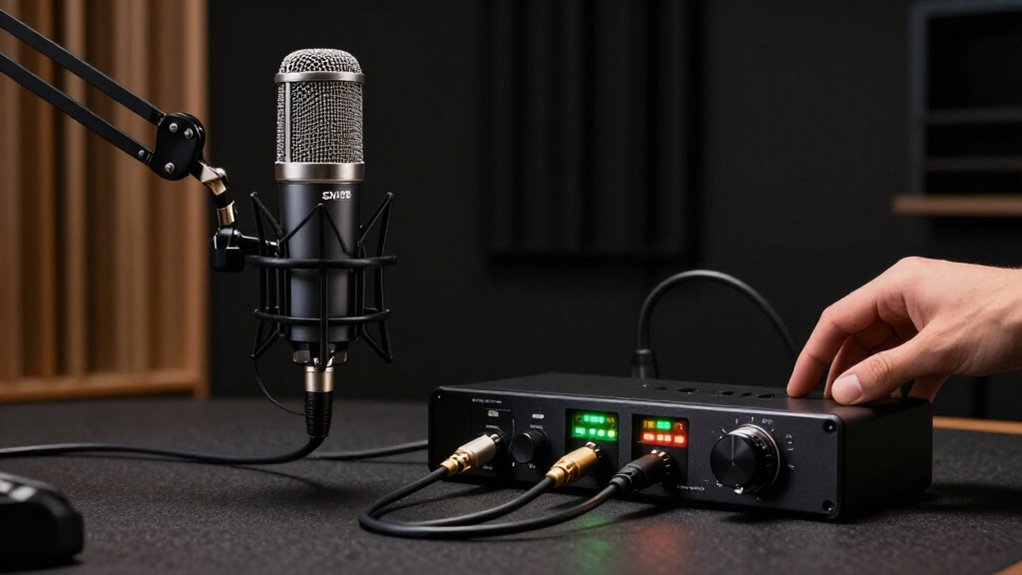
You don’t need a Cloudlifter for an SM7B if your interface provides roughly 65 dB of clean gain and your normal or whisper peaks land around −18 to −12 dBFS without objectionable hiss.
The SM7B’s −59 dBV sensitivity makes 60 dB typical, while quiet speech may need more.
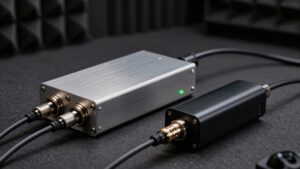
A Cloudlifter CL-1 adds about 25 dB and needs 48 V phantom power.
Solo 4th Gen’s 69 dB often suffices.
Below, you can test your setup precisely.
SM7B Gain: 60 dB
Why does the SM7B often get paired with a Cloudlifter? At typical speaking distance, you’ll need about 60 dB of clean preamp gain for usable SM7B levels. That requirement rises with quieter speech or greater mic distance. An interface limited to 56 dB, common on older budget models, can force its preamp near maximum, where headroom and noise performance may become less favorable.
A Cloudlifter supplies 25 dB inline, letting you run the interface lower. It is most practical when your interface delivers under about 58 to 60 dB of gain or has EIN poorer than approximately -124 dBV. Conversely, modern low-noise interfaces with 65 to 75 dB, including a Scarlett Gen 4 at about 69 dB, usually suffice. Moving from eight to three inches adds 8 to 10 dB.
SM7B’s −59 dBV Sensitivity
At roughly −59 dBV (1.12 mV/Pa), the Shure SM7B produces far less voltage than a typical condenser, so your preamp must add substantial clean gain to reach a usable recording level. That rating specifies output at 1 Pa (94 dB SPL); it doesn’t dictate gain setting.
Your requirement changes with source SPL, distance, angle, and proximity effect. At a close speaking position, many interfaces need about 60 dB of clean gain for levels. If yours provides that gain with low EIN, you can connect the SM7B directly. If it lacks gain or becomes noisy, a Cloudlifter’s 25 dB boost reduces interface gain.
Test your technique first: moving from eight inches to three inches can raise output 8 to 10 dB, eliminating the need for extra gain.
Whisper-Level Podcast Recording
Whisper-level podcasting pushes the SM7B’s gain demand beyond typical close-speech setups: start by verifying that your interface supplies roughly +65 dB of clean gain, with more required for very soft delivery or mic distances beyond 6 to 10 inches. At your actual recording distance, set gain and check whether whispers peak near −18 to −12 dBFS. If they don’t, insufficient level, not necessarily objectionable noise, is the limiting factor.
A Cloudlifter CL-1 adds about +25 dB before the preamp, letting a marginal interface reach normal peaks. It also helps when you must run a noisy preamp near maximum gain; performance worse than roughly −124 dBV EIN is a warning sign. Conversely, an interface offering 60 to 70 dB or more and EIN around −127 dBu to −129 dBV may suffice.
Cloudlifter CL-1 vs FetHead
You’ll compare the CL-1’s roughly +25 dB clean boost with the FetHead’s inline gain to determine whether your interface needs less preamp gain to reach about -18 to -12 dBFS. Noise differences matter only when your interface’s near-maximum gain raises the audible noise floor; a quiet +60 to +70 dB preamp may show little benefit from either unit.
Both use interface phantom power to run their circuitry while keeping it off your SM7B, so confirm 48 V availability and XLR compatibility.
Gain Boost Comparison
The Cloudlifter CL-1 supplies roughly +25 dB of gain before your interface preamp, potentially reducing an SM7B setup from about +60 dB of interface gain to roughly +35 dB. This upstream boost lets you run less interface gain while preserving the same target recording level.
The FetHead uses the same inline principle: it raises microphone level ahead of the preamp and provides a smaller, typically lower-cost alternative. Compare actual system requirements, not just form factor. If your SM7B use requires near-maximum preamp gain, either booster can move operation into a lower-gain range. At close speaking distance, the SM7B may deliver roughly 8 to 10 dB more level than at a farther distance, which can eliminate the need for extra gain. Verify your interface’s maximum clean gain.
Noise Performance Differences
Although the Cloudlifter CL-1 and FetHead can each add about +25 dB ahead of your interface, neither inherently removes noise; they improve SNR by reducing the gain your interface preamp must supply. With a quiet interface, whose EIN measures roughly -127 to -130 dBV at high gain, you’ll hear little difference between them: the preamp isn’t operating in its noisier upper range.
If its EIN is around -124 dBV or worse, either booster can improve recorded SNR more substantially by avoiding the extra gain. The deciding variable is preamp demand, not brand. When your SM7B already reaches -18 to -12 dBFS at moderate gain, hiss reduction remains minimal. Near maximum interface gain, both devices provide their largest practical noise advantage. Implementation differences don’t materially change that underlying mechanism.
Power And Compatibility
Power requirements and microphone type determine whether either booster will work in your SM7B chain. The Cloudlifter CL-1 needs +48 V phantom power from your interface, yet it uses that power internally and does not pass it to the connected microphone. It supplies roughly 25 dB of clean gain ahead of the interface preamp, making it useful only if your interface lacks sufficient clean gain or becomes noisy near maximum gain.
A FetHead serves the same dynamic/ribbon inline-booster role and may mount more conveniently directly at the microphone. Neither unit suits condenser microphones, whose phantom-power and impedance requirements differ.
With an SM7B, you can often omit either booster when your interface provides about 69 to 75 dB maximum gain and an A-weighted EIN near -127 dBu
Interface Preamp EIN Rating
Check your interface’s EIN alongside its maximum clean gain, since the SM7B typically needs about 60 dB without excessive noise.
You’ll generally want an A-weighted EIN near −127 to −130 dBV; readings worse than roughly −124 dBV can make hiss more apparent at high gain. Compare dBu versus dBV and weighted versus unweighted specifications carefully, as those reporting differences can shift results by about 2.2 dB.
Understanding EIN Measurements
EIN (equivalent input noise) tells you how much noise an interface preamp adds at maximum gain, making it one of the most useful specs for an SM7B. Manufacturers express it as a negative value, such as -127 dBuA or -129 dBV: a more-negative result indicates a quieter preamp. You can’t treat every published figure as interchangeable, however. Check the reference unit and weighting method before drawing conclusions.
dBu and dBV use different voltage references, while A-weighted and unweighted tests measure noise differently; these choices can shift stated results by roughly 2.2 dB. Evaluate EIN alongside available gain, since the SM7B’s low output makes both variables relevant. An interface near -129 to -130 dBV EIN, with sufficient clean gain, generally won’t require additional gain hardware.
Comparing Preamp Noise Floors
Although maximum gain determines whether you can reach a usable recording level, the interface’s EIN rating determines how much hiss its preamp contributes at that setting. When you compare interfaces, normalize the published figures before ranking them. An EIN near −127 dBu, A-weighted, equals roughly −129 dBV and identifies a very quiet preamp. Treat values worse than about −124 dBV as noisier, particularly if you need substantial microphone gain. Check whether the manufacturer states dBu or dBV, plus A-weighting or an unweighted bandwidth: these conventions can alter the quoted result by about 2.2 dB. If your interface measures around −129 to −130 dBV, its preamp noise floor is already low. You shouldn’t expect a Cloudlifter to reduce hiss originating elsewhere in recording chain meaningfully.
Gain Versus Noise Performance
Noise floor alone doesn’t decide whether an SM7B needs a Cloudlifter; you also need enough clean gain to place normal voice peaks around −18 to −12 dBFS. Check gain and EIN together. If your interface delivers +60 dB or more and rates near −127 dBV EIN or quieter, you can record without inline gain. Many modern units provide +70 to +80 dB and −127 dBu A-weighted, equivalent to about −129 dBV. More-negative EIN means less preamp noise when you raise gain. Consider Cloudlifter’s +25 dB only when gain falls below +58 dB or EIN is near −124 dBV or worse. It reduces preamp drive and may lower audible hiss. Compare conventions: dBu versus dBV and A-weighted versus unweighted figures may differ 2.2 dB.
Twitch Streaming Setups
For a Twitch setup, you only need a Cloudlifter CL-1 with an SM7B when your interface can’t supply enough clean gain for your speaking level and mic position. Target +60 dB of gain, or +65 dB if you speak quietly or keep the microphone farther away. Many interfaces meet that target; many older models, topping out around +56 to +60 dB, do not. In that case, the CL-1 adds +25 dB, letting you avoid running the interface at its gain limit.
Don’t judge the purchase by gain alone. Check input noise: an EIN of -127 to -129 dBV A-weighted is quiet enough that added gain may not reduce hiss. Move the mic from eight to three inches; that can raise level 8–10 dB.
Cloudlifter Requires Phantom Power
The Cloudlifter CL-1 needs +48V phantom power from your interface to generate its +25 dB inline gain, even though the Shure SM7B itself doesn’t require phantom power.
You enable phantom power on the interface channel feeding the CL-1, not because the SM7B needs it, but because the Cloudlifter’s active circuitry uses that supply to amplify the microphone signal before it reaches your mic preamp. The CL-1’s design blocks phantom power from passing to its microphone output, so you can connect a ribbon microphone without applying phantom to the mic. If your interface’s phantom supply is disabled, faulty, or unable to provide adequate voltage, the Cloudlifter won’t operate and your SM7B receives no inline gain. Check the channel’s +48V switch before troubleshooting low recording levels.
Cloudlifter Does Not Remove Noise
A Cloudlifter adds roughly 25 dB of clean gain ahead of your interface preamp, but it doesn’t remove hiss, room noise, or electrical interference already present in the signal chain. It changes gain staging, not the source noise floor. You can reduce preamp rotation, which may avoid the highest-gain hiss region, but every upstream contaminant remains.
- Your room, cables, and nearby electronics still enter the recording.
- The Cloudlifter amplifies unwanted signal along with your SM7B output.
- Interfaces with EIN near -127 to -130 dBV/A-weighted often show no meaningful improvement.
If your preamp’s self-noise rises audibly near maximum gain, lower interface gain can help. Measure recordings at matched output levels: a lower knob position alone isn’t evidence of lower noise. Identify sources before adding hardware.
Check Solo 4th-Gen’s 69 dB
Focus on the Solo 4th-Gen’s approximately +69 dB of mic-preamp gain: it exceeds the roughly +60 dB usually considered comfortable for an SM7B, so you can typically record close speech or vocals without a Cloudlifter. Set a 6 to 12-inch speaking or singing distance, then raise gain until your DAW averages roughly -18 to -12 dBFS.
If you reach that range without maxing the preamp control, the Solo provides adequate gain. A Cloudlifter’s +25 dB isn’t normally required. Consider one only if you whisper, work farther away, or can’t hit target level before maximum gain. If noise limits results, check published equivalent input noise (EIN): quiet modern preamps commonly measure about -127 to -129 dBV/A. Gain capacity alone doesn’t establish noise performance in every recording situation.
Conclusion
You don’t automatically need a Cloudlifter for an SM7B. Its −59 dBV sensitivity benefits from clean gain, but your interface determines the result: a Solo 4th Gen supplies up to 69 dB, exceeding the SM7B’s typical 60 dB target.
Test normal speech and whisper levels before buying. Add an inline booster only if you can’t reach recording level without excessive preamp noise. Remember, phantom power runs the Cloudlifter; it doesn’t remove room or source noise.