88 Key Vs 61 Key Keyboard: Which Size Fits Your Playing and Desk?
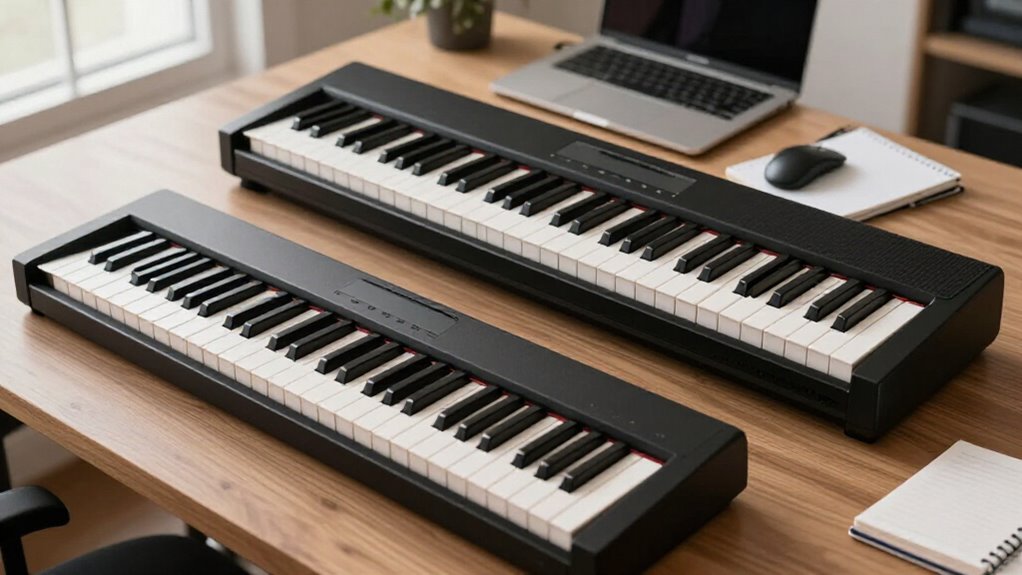
Choose a 61-key keyboard if you need a compact, roughly 39-inch-wide instrument for pop, production, or beginner practice within C2 to C7.
Choose 88 weighted keys if you play classical repertoire, need bass below C2 and treble above C7 simultaneously, or want acoustic-piano technique; expect about 52 inches of desk width.
Key count doesn’t determine polyphony, speakers, or USB-MIDI. Battery options favor many 61-key models, while the practical tradeoffs below clarify your best fit for your space.
27-Key Range Difference
A 61-key keyboard covers five octaves, typically C2 to C7, while an 88-key piano extends from A0 to C8 across seven and a quarter octaves. Those 27 additional notes divide into 12 lower notes and 15 upper notes. You gain the acoustic piano’s deepest bass for left-hand foundations and its highest treble for melodic or orchestral writing. A 61-key instrument handles beginner drills, pop material, and early classical repertoire, but you may need octave shifts or adapted scores when parts exceed C2 to C7.
| Range | 61-key | 88-key |
|---|---|---|
| Lowest note | C2 | A0 |
| Highest note | C7 | C8 |
| Added coverage | None | 12 bass; 15 treble |
Choose 88 keys for unaltered full-range scores; choose 61 for central repertoire and a smaller desk footprint. Key count doesn’t determine action; models do.
Polyphony, Pedals, and Presets
Beyond range, polyphony determines how many notes your keyboard can produce simultaneously. For sustained piano playing, 88-key digital pianos often provide 128 to 256 notes of polyphony, so held notes and layered voices are less likely to cut off. However, a 61-key model can offer equally high polyphony because its key count sets pitch range, not sound-engine capacity.
Both sizes commonly accept a sustain pedal, which lets notes ring after you release the keys. Verify whether the pedal comes in the box and whether the input supports your pedal type. If you want variety, 61-key keyboards often include more presets, rhythms, and backing tracks. Most 88-key pianos prioritize piano sounds. Compare each model’s polyphony, pedal support, and presets rather than assuming size determines features.
Octave Reach in Classical Pieces
Octave range directly affects which classical scores you can play as written. A 61-key keyboard covers five octaves, enough for many beginner works, but it can’t include low bass tones and high treble notes found in later repertoire. In Chopin, Beethoven, and Debussy, even intermediate selections may exceed that span, forcing adapted passages, transposition, or a different instrument.
An 88-key piano runs from A0 to C8 across seven and a quarter octaves, matching the acoustic-piano standard. You can perform the written register without moving material into another octave. Advanced Chopin, Liszt, Debussy, Rachmaninoff, and late Beethoven often need this complete range. If classical study matters to you, inspect your planned repertoire early. Many students need 88 keys within one to two years of study.
Octave-Button Dependence for Beginners
For beginners, octave buttons can offset a 61-key keyboard’s limited span when music reaches below or above its five-octave layout. Many early exercises and songs stay within those five octaves, so you won’t need to shift while learning basic hand positions and note-reading patterns. When a line extends beyond the keys, you press an octave button to transpose the available notes up or down and continue playing.
This solution suits pop, songwriting, and compact instruments, but repeated shifts can break your timing or concentration when a piece jumps between distant registers. Before choosing, inspect the ranges in your planned repertoire. Some beginner scores fit directly; wider-ranging classical works may require shifts, adaptation, or an 88-key model. Buttons expand pitch access, not key count or action.
USB-MIDI and Desk-Stand Fit
Both 61- and 88-key keyboards commonly include USB-MIDI, letting you send note and control data to a computer, recording program, or learning app without transmitting the keyboard’s audio. Before you buy, verify the model’s USB connection type and its compatibility with your computer, software, or preferred app; implementations vary.
For physical placement, a 61-key model measures roughly 39 inches wide and usually fits desks or keyboard trays more easily. An 88-key model spans about 52 inches, so measure usable desk width rather than the desktop’s outside edges. If you use a stand, map its entire footprint: stand legs, bench position, cable routing, and elbow clearance. You’ll play more comfortably when the keyboard sits securely at a workable height and leaves enough room to move.
Resale Value and Repair Parts
Resale value depends more on the exact model, condition, included accessories, and local demand than on whether a keyboard has 61 or 88 keys. Compare recent sold listings for your exact model; don’t assume either size retains value better. A complete, tested package sells faster, while an 88-key board can cost more to store or transport than a compact 61-key unit.
- Keep the original power supply, sustain pedal, stand hardware, manuals, and packaging.
- Confirm that the manufacturer or authorized service center can source keys, pedals, power supplies, and model-specific components.
- Check warranty terms; Donner’s listed store policy provides one year of free repair or replacement.
Before buying, test each key, connector, control, and pedal input. You’ll reduce repair risk and present a better-documented instrument when you sell.
Built-In Speaker Volume Limits
Speaker output is a separate buying check: a keyboard’s built-in volume depends on its amplifier, speaker size, enclosure, and sound engine, not on whether it has 61 or 88 keys.
Don’t assume an 88-key model will fill a room better than a 61-key alternative. Check each model’s rated output, speaker configuration, and cabinet design, then listen from your normal playing position. A modest speaker system can sound thin or reach its limit at higher levels, regardless of key count. If you need quiet practice, use headphones.
If you need more level or broader coverage, connect external amplification; this lets you choose speakers suited to your room and audience. You’ll get more consistent results than relying on a keyboard’s internal speakers for rehearsal or small gatherings.
Battery Power Versus AC Only
Many 61-key keyboards can run on batteries, so you can practice where outlet access is limited. Most 88-key digital pianos require AC power and a dedicated location, so plan their placement around a mains outlet. Key count doesn’t guarantee battery operation; check each model’s battery type, runtime, and AC options before you buy.
Portable Battery Power
Battery capability gives many 61-key keyboards a practical advantage when you need to play away from an outlet. Their battery operation lets you move between rooms, take lessons, or practice in dorms, shared spaces, and on trips without planning your setup around fixed power access.
- Compare whether batteries are supported, not merely included.
- Check published runtime under realistic speaker and headphone use.
- Balance battery flexibility against total carry weight and case space.
Most 88-key digital pianos target stationary use, so battery operation is less common. Before buying, confirm the exact model’s battery option and estimate how often you’ll transport it. A compact keyboard with useful runtime may suit mobile practice better, while an 88-key model can make sense if it’s staying in one place.
AC Power Considerations
Power requirements can shape how and where you use a keyboard: compact 61-key models often run on batteries or AC power, while most 88-key digital pianos require an outlet and suit a fixed setup. That distinction affects placement, cable management, and backup planning. If you choose an 88-key piano, reserve an accessible wall outlet and route its adapter cable safely; it’s designed to stay connected in a studio, practice area, or home workstation.
A 61-key keyboard may give you more flexibility, but don’t assume battery operation: verify the specific model, battery format, expected runtime, and AC input. Also check whether the adapter comes in the box. An included adapter reduces setup costs, while battery capability lets you keep playing during moves, outdoor sessions, or outages.
Band Practice: Left-Hand Bass
For left-hand bass, check whether your lowest notes fit a 61-key keyboard’s five-octave range; if they don’t, you’ll need octave shift or a revised part. An 88-key model gives you more low-end space, so you can cover bass lines without shifting during songs. Choose action separately from range: you may prefer a light 61-key board for fast synth work or weighted 88 keys for piano-like control.
Low-End Range Requirements
A 61-key keyboard, typically spanning C2–C7, gives you enough low range for many band-practice bass roots and left-hand chord tones, while an 88-key piano extends down to A0 for parts written substantially lower. That difference matters only when your arrangement actually calls for notes below C2. Before buying, inspect the lowest written pitches across your set list and account for the register assigned to keys. If every required note remains at or above C2, a 61-key model keeps the setup compact without limiting your functional role. Choose 88 keys when the music specifically demands lower written notes and preserving the original register matters.
- Verify lowest charted pitch before committing.
- Match keyboard range to arranged key part.
- Reserve 88 keys for actual documented sub-C2 requirements.
Bass Lines and Octaves
When you cover left-hand bass in band practice, a 61-key keyboard usually supplies enough range for common roots, walking figures, and chord-based bass patterns, but some songs may place their lowest notes below its bottom key.
Check each song’s lowest pitch against your instrument’s range. If a part drops below the 61-key limit, shift it up an octave when the arrangement permits; otherwise, an 88-key model preserves the register. Its A0-to-C8 range leaves room for bass tones while your right hand handles chords or melody.
Key count changes pitch coverage, not action: 61-key boards often use light keys, whereas 88-key pianos use weighted actions. Lock your left hand to a metronome. Add melody only after roots, passing tones, and octave changes remain rhythmically even.
Rehearsal Setup Tradeoffs
Your rehearsal setup should match the bass role you’ll actually cover. A 61-key board usually gives you enough five-octave range for left-hand bass plus right-hand chords or melodies in pop, rock, worship, and contemporary sets. Its compact footprint also simplifies transport and stand placement.
- Choose 61 keys if a bassist covers the lowest register; verify each song’s lowest written note.
- Choose an 88-key piano when you must sustain low bass and high parts simultaneously, without octave shifts.
- Treat action separately: 61-key models are often light or semi-weighted, while 88-key digital pianos commonly use weighted hammer action.
Octave buttons extend a smaller board’s reach, but they can interrupt lines requiring bass and treble notes at once. Prioritize simultaneous range over portability when charts demand it.
Hammer Action and Finger Strength
Hammer-action keys create resistance and return behavior closer to an acoustic piano, unlike the lighter spring-loaded action common on many 61-key keyboards. That load makes you regulate attack, release, and finger independence rather than relying on shallow, easy key travel. On 88-key models, graded hammer action typically feels heavier in the bass and progressively lighter in the treble, mirroring piano mechanics.
You’ll build more strength, control, and dynamic touch when you practice scales, chords, and repertoire against this resistance. A 61-key unweighted board still lets you learn notes, harmony, timing, and many production parts efficiently. However, it won’t reinforce the same piano-specific technique. Choose 88 weighted keys if you’re preparing classical pieces or expect to move between your keyboard and an acoustic piano.
Conclusion
Choose 88 keys if you need full piano range, weighted hammer action, dependable pedal control, and left-hand bass for classical study or band rehearsal. Choose 61 keys if your desk is tight, you travel often, or you mainly use USB-MIDI, presets, and octave buttons. You’ll sacrifice immediate low and high register access, not necessarily polyphony or sound quality. Check speaker output, power options, stand width, and whether your practice goals justify the larger footprint today.